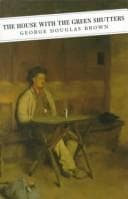
The House with the Green ShuttersBrown, George Douglas
General
The House with the Green Shutters
Brown, George Douglas
Scotland -- Social life and customs -- 19th century -- Fiction
And that, on a lower level, was what whisky did. He had no conception
of what Tam really meant; there were people, indeed, who used to think
that Tam never knew what he meant himself. They were as little able as
Gourlay to appreciate the mystic, through the radiant haze of whose mind
thoughts loomed on you sudden and big, like mountain tops in a sunny
mist, the grander for their dimness. But Gourlay, though he could not
understand, felt the fortitude of whisky was somehow akin to the
fortitude described. In the increased vitality it gave he was able to
tread down the world. If he walked on a wretched day in a wretched
street, when he happened to be sober, his mind was hither and yon in a
thousand perceptions and a thousand fears, fastening to (and fastened
to) each squalid thing around. But with whisky humming in his blood he
paced onward in a happy dream. The wretched puddles by the way, the
frowning rookeries where misery squalled, the melancholy noises of the
street, were passed unheeded by. His distracted powers rallied home; he
was concentrate, his own man again, the hero of his musing mind. For,
like all weak men of a vivid fancy, he was constantly framing dramas of
which he was the towering lord. The weakling who never "downed" men in
reality was always "downing" them in thought. His imaginary triumphs
consoled him for his actual rebuffs. As he walked in a tipsy dream, he
was "standing up" to somebody, hurling his father's phrases at him,
making short work of _him_! If imagination paled, the nearest tavern
supplied a remedy, and flushed it to a radiant glow. Whereupon he had
become the master of his world, and not its slave.
"Just imagine," he thought, "whisky doing for me what philosophy seems
to do for Tam. It's a wonderful thing the drink!"
His second session wore on, and when near its close Tam gave out the
subject for the Raeburn.
The Raeburn was a poor enough prize--a few books for an "essay in the
picturesque;" but it had a peculiar interest for the folk of Barbie.
Twenty years ago it was won four years in succession by men from the
valley; and the unusual run of luck fixed it in their minds. Thereafter
when an unsuccessful candidate returned to his home, he was sure to be
asked very pointedly, "Who won the Raeburn the year?" to rub into him
their perception that he at least had been a failure. A bodie would
dander slowly up, saying, "Ay, man, ye've won hame!" Then, having mused
awhile, would casually ask, "By-the-bye, who won the Raeburn the year?
Oh, it was a Perthshire man! It used to come our airt, but we seem to
have lost the knack o't! Oh yes, sir, Barbie bred writers in those days,
but the breed seems to have decayed." Then he would murmur dreamily, as
if talking to himself, "Jock Goudie was the last that got it hereaway.
But _he_ was a clever chap."
Public-domain text, read in full here on John Shaqi.
Reviews
Reviews
No reviews yet
Be the first to share your thoughts on this work.
Elsewhere in the archive
Join the Discussion
Join the discussion
Sign in to leave a comment or review.
Sign InorCreate an account