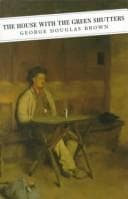
The House with the Green ShuttersBrown, George Douglas
General
The House with the Green Shutters
Brown, George Douglas
Scotland -- Social life and customs -- 19th century -- Fiction
"Oh, he would be sure to think there was something in it," said the
minister, staring, and wagging his pow. "Not a doubt of tha-at, not a
doubt of tha-at! There must have been something in it to obtain the palm
of victory in the face of such prodigious competeetion. It's the
see-lect intellect of Scotland that goes to the Univairsity, and only
the ee-lect of the see-lect win the palm. And it's an augury of great
good for the future. Abeelity to write is a splendid thing for the
Church. Good-bye, John, and allow me to express once moar my great
satisfaction that a pareeshioner of mine is a la-ad of such brilliant
promise!"
Though the elder Gourlay disconsidered the Church, and thought little of
Mr. Struthers, he swelled with pride to think that the minister should
stop his offspring in the Main Street of Barbie, to congratulate him on
his prospects. They were close to the Emporium, and with the tail of his
eye he could see Wilson peeping from the door and listening to every
word. This would be a hair in Wilson's neck! There were no clerical
compliments for _his_ son! The tables were turned at last.
His father had a generous impulse to John for the bright triumph he had
won the Gourlays. He fumbled in his trouser pocket, and passed him a
sovereign.
"I'm kind o' hard-up," he said, with grim jocosity, "but there's a pound
to keep your pouch. No nonsense now!" he shot at the youth with a loaded
eye. "That's just for use if you happen to be in company. A Gourlay maun
spend as much as the rest o' folk."
"Yes, faither," said the youngster, and Gourlay went away.
That grimly-jocose reference to his poverty was a feature of Gourlay's
talk now, when he spoke of money to his family. It excused the smallness
of his doles, yet led them to believe that he was only joking--that he
had plenty of money if he would only consent to shell it out. And that
was what he wished them to believe. His pride would not allow him to
confess, even to his nearest, that he was a failure in business, and
hampered with financial trouble. Thus his manner of warning them to be
careful had the very opposite effect. "He has heaps o' cash," thought
the son, as he watched the father up the street; "there's no need for a
fellow to be mean."
Public-domain text, read in full here on John Shaqi.
Reviews
Reviews
No reviews yet
Be the first to share your thoughts on this work.
Elsewhere in the archive
Join the Discussion
Join the discussion
Sign in to leave a comment or review.
Sign InorCreate an account