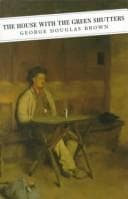
The House with the Green ShuttersBrown, George Douglas
General
The House with the Green Shutters
Brown, George Douglas
Scotland -- Social life and customs -- 19th century -- Fiction
Gourlay went out to the big green gate where he had often stood in his
pride, and watched his old servant going down the street. Peter was so
bowed that the back of his velveteen coat was halfway up his spine, and
the bulging pockets at the corners were midway down his thighs. Gourlay
had seen the fact a thousand times, but it never gripped him before. He
stared till Peter disappeared round the Bend o' the Brae.
"Ay, ay," said he, "ay, ay. There goes the last o' them."
It was a final run of ill-luck that brought Gourlay to this desperate
pass. When everything seemed to go against him he tried several
speculations, with a gambler's hope that they might do well, and
retrieve the situation. He abandoned the sensible direction of affairs,
that is, and trusted entirely to chance, as men are apt to do when
despairing. And chance betrayed him. He found himself of a sudden at the
end of his resources.
Through all his troubles his one consolation was the fact that he had
sent John to the University. That was something saved from the wreck, at
any rate. More and more, as his other supports fell away, Gourlay
attached himself to the future of his son. It became the sheet-anchor of
his hopes. If he had remained a prosperous man, John's success would
have been merely incidental, something to disconsider in speech, at
least, however pleased he might have been at heart. But now it was the
whole of life to him. For one thing, the son's success would justify the
father's past and prevent it being quite useless; it would have produced
a minister, a successful man, one of an esteemed profession. Again, that
success would be a salve to Gourlay's wounded pride; the Gourlays would
show Barbie they could flourish yet, in spite of their present downcome.
Thus, in the collapse of his fortunes, the son grew all-important in the
father's eyes. Nor did his own poverty seem to him a just bar to his
son's prosperity. "I have put him through his Arts," thought Gourlay;
"surely he can do the rest himsell. Lots of young chaps, when they
warstle through their Arts, teach the sons of swells to get a little
money to gang through Diveenity. My boy can surely do the like!" Again
and again, as Gourlay felt himself slipping under in the world of
Barbie, his hopes turned to John in Edinburgh. If that boy would only
hurry up and get through, to make a hame for the lassie and the auld
wife!
CHAPTER XXIII.
Young Gourlay spent that winter in Edinburgh pretty much as he had spent
the last. Last winter, however, it was simply a weak need for
companionship that drew him to the Howff. This winter it was more: it
was the need of a formed habit that must have its wonted satisfaction.
He had a further impulse to conviviality now. It had become a habit that
compelled him.
Public-domain text, read in full here on John Shaqi.
Reviews
Reviews
No reviews yet
Be the first to share your thoughts on this work.
Elsewhere in the archive
Join the Discussion
Join the discussion
Sign in to leave a comment or review.
Sign InorCreate an account