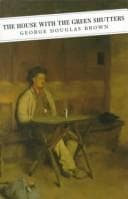
The House with the Green ShuttersBrown, George Douglas
General
The House with the Green Shutters
Brown, George Douglas
Scotland -- Social life and customs -- 19th century -- Fiction
Gourlay was sitting alone in his room when he heard that he had been
expelled. For many days he had drunk to deaden fear, but he was sober
now, being newly out of bed. A dreary ray of sunshine came through the
window, and fell on a wisp of flame blinking in the grate. As Gourlay
sat, his eyes fixed dully on the faded ray, a flash of intuition laid
his character bare to him. He read himself ruthlessly. It was not by
conscious effort; insight was uncanny and apart from will. He saw that
blatancy had joined with weakness, morbidity with want of brains; and
that the results of these, converging to a point, had produced the
present issue, his expulsion. His mind recognized how logical the issue
was, assenting wearily as to a problem proved. Given those qualities, in
those circumstances, what else could have happened? And such a weakling
as he knew himself to be could never--he thought--make effort sufficient
to alter his qualities. A sense of fatalism came over him, as of one
doomed. He bowed his head, and let his arms fall by the sides of his
chair, dropping them like a spent swimmer ready to sink. The sudden
revelation of himself to himself had taken the heart out of him. "I'm a
waster!" he said aghast. And then, at the sound of his own voice, a fear
came over him, a fear of his own nature; and he started to his feet and
strode feverishly, as if by mere locomotion, to escape from his clinging
and inherent ill. It was as if he were trying to run away from himself.
He faced round at the mirror on his mantel, and looked at his own image
with staring and startled eyes, his mouth open, the breath coming hard
through his nostrils. "You're a gey ill ane," he said; "you're a gey ill
ane! My God, where have you landed yourself?"
He went out to escape from his thoughts. Instinctively he turned to the
Howff for consolation.
With the panic despair of the weak, he abandoned hope of his character
at its first collapse, and plunged into a wild debauch, to avoid
reflecting where it would lead him in the end. But he had a more
definite reason for prolonging his bout in Edinburgh. He was afraid to
go home and meet his father. He shrank, in visioning fear, before the
dour face, loaded with scorn, that would swing round to meet him as he
entered through the door. Though he swore every night in his cups that
he would "square up to the Governor the morn, so he would!" always, when
the cold light came, fear of the interview drove him to his cups again.
His courage zigzagged, as it always did; one moment he towered in
imagination, the next he grovelled in fear.
Public-domain text, read in full here on John Shaqi.
Reviews
Reviews
No reviews yet
Be the first to share your thoughts on this work.
Elsewhere in the archive
Join the Discussion
Join the discussion
Sign in to leave a comment or review.
Sign InorCreate an account