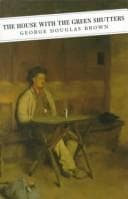
The House with the Green ShuttersBrown, George Douglas
General
The House with the Green Shutters
Brown, George Douglas
Scotland -- Social life and customs -- 19th century -- Fiction
But wrath clung round him like a garment. His anger fed on its
uncertainties. For that is the beauty of the Wilson method of insult:
you leave the poison in your victim's blood, and he torments himself.
"Was Wilson referring to _me_, after all?" he pondered slowly; and his
body surged at the thought. "If he was, I have let him get away
unkilled," and he clutched the hands whence Wilson had escaped. Suddenly
a flashing thought stopped him dead in the middle of his walk, staring
hornily before him. He had seen the point at last that a quicker man
would have seized on at the first. Why had Wilson thrust his damned
voice on him on this particular morning of all days in the year, if he
was not gloating over some news which he had just heard about the
Gourlays? It was as plain as daylight: his son had sent word from
Edinburgh. That was why he brayed and ho-ho-hoed when Gourlay went by.
Gourlay felt a great flutter of pulses against his collar; there was a
pain in his throat, an ache of madness in his breast. He turned once
more. But Wilson and the Templar had withdrawn discreetly to the Black
Bull; the street wasna canny. Gourlay resumed his way, his being a dumb
gowl of rage. His angry thought swept to John. Each insult, and fancied
insult, he endured that day was another item in the long account of
vengeance with his son. It was John who had brought all this flaming
round his ears--John whose colleging he had lippened to so muckle. The
staff on which he leaned had pierced him. By the eternal heavens he
would tramp it into atoms. His legs felt John beneath them.
As the market grew busy, Gourlay was the aim of innumerable eyes. He
would turn his head to find himself the object of a queer, considering
look; then the eyes of the starer would flutter abashed, as though
detected spying the forbidden. The most innocent look at him was poison.
"Do they know?" was his constant thought; "have they heard the news?
What's Loranogie looking at me like that for?"
Not a man ventured to address him about John--he had cowed them too
long. One man, however, showed a wish to try. A pretended sympathy, from
behind the veil of which you probe a man's anguish at your ease, is a
favourite weapon of human beasts anxious to wound. The Deacon longed to
try it on Gourlay. But his courage failed him. It was the only time he
was ever worsted in malignity. Never a man went forth, bowed down with a
recent shame, wounded and wincing from the public gaze, but that old
rogue hirpled up to him, and lisped with false smoothness: "Thirce me,
neebour, I'm thorry for ye! Thith ith a _terrible_ affair! It'th on
everybody'th tongue. But ye have my thympathy, neebour, ye have
tha-at--my warmetht thympathy." And all the while the shifty eyes above
the lying mouth would peer and probe, to see if the soul within the
other was writhing at his words.
Public-domain text, read in full here on John Shaqi.
Reviews
Reviews
No reviews yet
Be the first to share your thoughts on this work.
Elsewhere in the archive
Join the Discussion
Join the discussion
Sign in to leave a comment or review.
Sign InorCreate an account