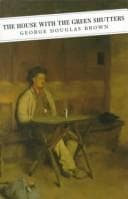
The House with the Green ShuttersBrown, George Douglas
General
The House with the Green Shutters
Brown, George Douglas
Scotland -- Social life and customs -- 19th century -- Fiction
He walked blindly to the kitchen door, never knowing how he reached it.
It was locked--at this early hour!--and the simple inconvenience let
loose the fury of his wrath. He struck the door with his clenched fist
till the blood streamed on his knuckles.
It was Mrs. Gourlay who opened the door to him. She started back before
his awful eyes.
"John!" she cried, "what's wrong wi' ye?"
The sight of the she-tatterdemalion there before him, whom he had
endured so long and must endure for ever, was the crowning burden of his
night. Damn her, why didn't she get out of the way? why did she stand
there in her dirt and ask silly questions? He struck her on the bosom
with his great fist, and sent her spinning on the dirty table.
She rose from among the broken dishes and came towards him, with slack
lips and great startled eyes. "John," she panted, like a pitiful
frightened child, "what have I been doing?... Man, what did you hit me
for?"
He gaped at her with hanging jaw. He knew he was a brute--knew she had
done nothing to-night more than she had ever done--knew he had vented on
her a wrath that should have burst on others. But his mind was at a
stick; how could he explain--to _her_? He gaped and glowered for a
speechless moment, then turned on his heel and went into the parlour,
slamming the door till the windows rattled in their frames.
She stared after him a while in large-eyed stupor, then flung herself in
her old nursing-chair by the fire, and spat blood in the ribs, hawking
it up coarsely--we forget to be delicate in moments of supremer agony.
And then she flung her apron over her head and rocked herself to and fro
in the chair where she had nursed his children, wailing, "It's a pity o'
me, it's a pity o' me! My God, ay, it's a geyan pity o' me!"
The boy was in bed, but Janet had watched the scene with a white, scared
face and tearful cries. She crept to her mother's side.
The sympathy of children with those who weep is innocently selfish. The
sight of tears makes them uncomfortable, and they want them to cease, in
the interests of their own happiness. If the outward signs of grief
would only vanish, all would be well. They are not old enough to
appreciate the inward agony.
So Janet tugged at the obscuring apron, and whimpered, "Don't greet,
mother, don't greet. Woman, I dinna like to see ye greetin'."
But Mrs. Gourlay still rocked herself and wailed, "It's a pity o' me,
it's a pity o' me! My God, ay, it's a geyan pity o' me!"
CHAPTER XIII.
"Is he in himsell?" asked Gibson the builder, coming into the Emporium.
Mrs. Wilson was alone in the shop. Since trade grew so brisk she had an
assistant to help her, but he was out for his breakfast at present, and
as it happened she was all alone.
"No," she said, "he's no in. We're terribly driven this twelvemonth
back, since trade grew so thrang, and he's aye hunting business in some
corner. He's out the now after a carrying affair. Was it ainything
perticular?"
Public-domain text, read in full here on John Shaqi.
Reviews
Reviews
No reviews yet
Be the first to share your thoughts on this work.
Elsewhere in the archive
Join the Discussion
Join the discussion
Sign in to leave a comment or review.
Sign InorCreate an account