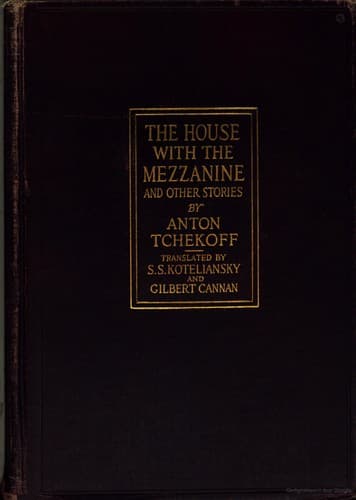
The House with the Mezzanine and Other StoriesChekhov, Anton Pavlovich
General
The House with the Mezzanine and Other Stories
Chekhov, Anton Pavlovich
Short stories
And they would go away. After that, Stiepan would put away the bundle of
cracknels or the shirt they had left for him and sigh and give a wink in
their direction and say:
"The female sex!"
The mill was worked with both wheels day and night. I used to help
Stiepan, I liked it, and when he went away I was glad to take his place.
XI
After a spell of warm bright weather we had a season of bad roads. It
rained and was cold all through May. The grinding of the millstones and
the drip of the rain induced idleness and sleep. The floor shook, the
whole place smelled of flour, and this too made one drowsy. My wife in a
short fur coat and high rubber boots used to appear twice a day and she
always said the same thing:
"Call this summer! It is worse than October!"
We used to have tea together and cook porridge, or sit together for
hours in silence thinking the rain would never stop. Once when Stiepan
went away to a fair, Masha stayed the night in the mill. When we got up
we could not tell what time it was for the sky was overcast; the sleepy
cocks at Dubechnia were crowing, and the corncrakes were trilling in the
meadow; it was very, very early.... My wife and I walked down to the
pool and drew up the bow-net that Stiepan had put out in our presence
the day before. There was one large perch in it and a crayfish angrily
stretched out his claws.
"Let them go," said Masha. "Let them be happy too."
Because we got up very early and had nothing to do, the day seemed very
long, the longest in my life. Stiepan returned before dusk and I went
back to the farmhouse.
"Your father came here to-day," said Masha.
"Where is he?"
"He has gone. I did not receive him."
Seeing my silence and feeling that I was sorry for my father, she said:
"We must be logical. I did not receive him and sent a message to ask him
not to trouble us again and not to come and see us."
In a moment I was outside the gates, striding toward the town to make it
up with my father. It was muddy, slippery, cold. For the first time
since our marriage I suddenly felt sad, and through my brain, tired with
the long day, there flashed the thought that perhaps I was not living as
I ought; I got more and more tired and was gradually overcome with
weakness, inertia; I had no desire to move or to think, and after
walking for some time, I waved my hand and went home.
In the middle of the yard stood the engineer in a leather coat with a
hood. He was shouting:
"Where's the furniture? There was some good Empire furniture, pictures,
vases. There's nothing left! Damn it, I bought the place with the
furniture!"
Near him stood Moissey, Mrs. Cheprakov's bailiff, fumbling with his cap;
a lank fellow of about twenty-five, with a spotty face and little,
impudent eyes; one side of his face was larger than the other as though
he had been lain on.
"Yes, Right Honourable Sir, you bought it without the furniture," he
said sheepishly. "I remember that clearly."
Public-domain text, read in full here on John Shaqi.
Reviews
Reviews
No reviews yet
Be the first to share your thoughts on this work.
Elsewhere in the archive
Join the Discussion
Join the discussion
Sign in to leave a comment or review.
Sign InorCreate an account