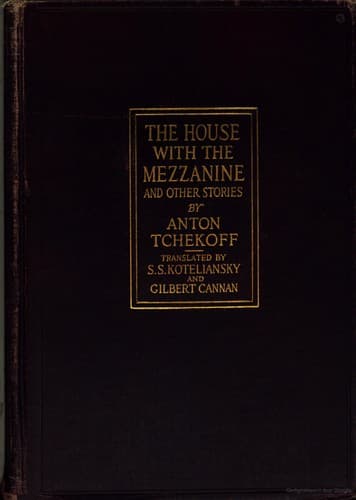
The House with the Mezzanine and Other StoriesChekhov, Anton Pavlovich
General
The House with the Mezzanine and Other Stories
Chekhov, Anton Pavlovich
Short stories
She was exasperated and a fury was gathering in her soul, and I, on the
other hand, was getting used to the peasants and more and more attracted
to them. For the most part, they were nervous, irritable, absurd people;
they were people with suppressed imaginations, ignorant, with a bare,
dull outlook, always dazed by the same thought of the grey earth, grey
days, black bread; they were people driven to cunning, but, like birds,
they only hid their heads behind the trees--they could not reason. They
did not come to us for the twenty roubles earned by haymaking, but for
the half-pail of vodka, though they could buy four pails of vodka for
the twenty roubles. Indeed they were dirty, drunken, and dishonest, but
for all that one felt that the peasant life as a whole was sound at the
core. However clumsy and brutal the peasant might look as he followed
his antiquated plough, and however he might fuddle himself with vodka,
still, looking at him more closely, one felt that there was something
vital and important in him, something that was lacking in Masha and the
doctor, for instance, namely, that he believes that the chief thing on
earth is truth, that his and everybody's salvation lies in truth, and
therefore above all else on earth he loves justice. I used to say to my
wife that she was seeing the stain on the window, but not the glass
itself; and she would be silent or, like Stiepan, she would hum,
"U-lu-lu-lu...." When she, good, clever actress that she was, went pale
with fury and then harangued the doctor in a trembling voice about
drunkenness and dishonesty; her blindness confounded and appalled me.
How could she forget that her father, the engineer, drank, drank
heavily, and that the money with which he bought Dubechnia was acquired
by means of a whole series of impudent, dishonest swindles? How could
she forget?
XIV
And my sister, too, was living with her own private thoughts which she
hid from me. She used often to sit whispering with Masha. When I went up
to her, she would shrink away, and her eyes would look guilty and full
of entreaty. Evidently there was something going on in her soul of which
she was afraid or ashamed. To avoid meeting me in the garden or being
left alone with me she clung to Masha and I hardly ever had a chance to
talk to her except at dinner.
One evening, on my way home from the school, I came quietly through the
garden. It had already begun to grow dark. Without noticing me or
hearing footsteps, my sister walked round an old wide-spreading
apple-tree, perfectly noiselessly like a ghost. She was in black, and
walked very quickly, up and down, up and down, with her eyes on the
ground. An apple fell from the tree, she started at the noise, stopped
and pressed her hands to her temples. At that moment I went up to her.
In an impulse of tenderness, which suddenly came rushing to my heart,
with tears in my eyes, somehow remembering our mother and our childhood,
I took hold of her shoulders and kissed her.
Public-domain text, read in full here on John Shaqi.
Reviews
Reviews
No reviews yet
Be the first to share your thoughts on this work.
Elsewhere in the archive
Join the Discussion
Join the discussion
Sign in to leave a comment or review.
Sign InorCreate an account