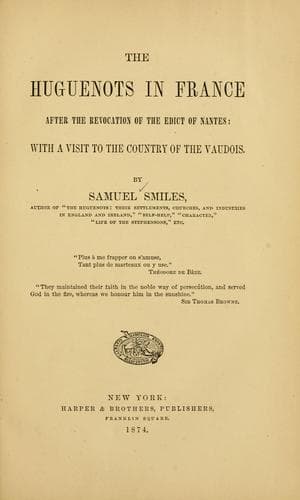
Dauphiné (France) -- Description and travel; Huguenots; Waldenses
The Royalists had scarcely advanced to the attack of the bridge, when
the concealed Camisards rushed out and assailed their rear, while
those stationed above hurled down rocks and stones, which threw them
into complete disorder. They at once broke and fled, rushing down to
the river, into which they threw themselves; and but for Roland's
neglect in guarding the steep footpath leading to the ford at the
mill, the whole body would have been destroyed. As it was, they
suffered heavy loss, the general himself escaping with difficulty,
leaving his white-plumed hat behind him in the hands of the Camisards.
CHAPTER VIII.
END OF THE CAMISARD INSURRECTION.
The insurrection in the Cevennes had continued for more than two
years, when at length it began to excite serious uneasiness at
Versailles. It was felt to be a source of weakness as well as danger
to France, then at war with Portugal, England, and Savoy. What
increased the alarm of the French Government was the fact that the
insurgents were anxiously looking abroad for help, and endeavouring to
excite the Protestant governments of the North to strike a blow in
their behalf.
England and Holland had been especially appealed to. Large numbers of
Huguenot soldiers were then serving in the English army; and it was
suggested that if they could effect a landing on the coast of
Languedoc, and co-operate with the Camisards, it would at the same
time help the cause of religious liberty, and operate as a powerful
diversion in favour of the confederate armies, then engaged with the
armies of France in the Low Countries and on the Rhine.
In order to ascertain the feasibility of the proposed landing, and the
condition of the Camisard insurgents, the ministry of Queen Anne sent
the Marquis de Miremont, a Huguenot refugee in England, on a mission
to the Cevennes; and he succeeded in reaching the insurgent camp at
St. Felix, where he met Roland and the other leaders, and arranged
with them for the descent of a body of Huguenot soldiers on the coast.
In the month of September, 1703, the English fleet was descried in the
Gulf of Lyons, off Aiguesmortes, making signals, which, however, were
not answered. Marshal Montrevel had been warned of the intended
invasion; and, summoning troops from all quarters, he so effectually
guarded the coast, that a landing was found impracticable. Though
Cavalier was near at hand, he was unable at any point to communicate
with the English ships; and after lying off for a few days, they
spread their sails, and the disheartened Camisards saw their intended
liberators disappear in the distance.
Public-domain text, read in full here on John Shaqi.
Reviews
Reviews
No reviews yet
Be the first to share your thoughts on this work.
Elsewhere in the archive
Join the Discussion
Join the discussion
Sign in to leave a comment or review.
Sign InorCreate an account