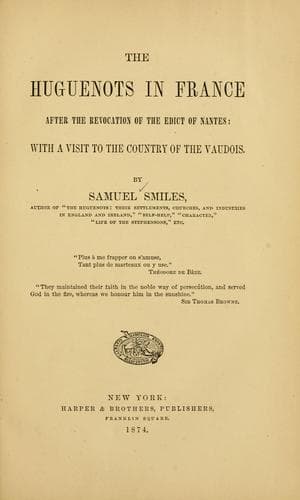
Dauphiné (France) -- Description and travel; Huguenots; Waldenses
The intelligence became known to Cavalier, who now watched the
Montpellier road, for the purpose of inflicting a parting blow upon
his often-baffled enemy. Instead, however, of Montrevel setting out
for Montpellier with a small force, he mustered almost the entire
troops belonging to the garrison of Nismes--over six thousand horse
and foot--and determined to overwhelm Cavalier, who lay in his way.
Montrevel divided his force into several bodies, and so disposed them
as completely to surround the comparatively small Camisard force,
near Langlade. The first encounter was with the royalist regiment of
Firmarcon, which Cavalier completely routed; but while pursuing them
too keenly, the Camisards were assailed in flank by a strong body of
foot posted in vineyards along the road, and driven back upon the main
body. The Camisards now discovered that a still stronger battalion was
stationed in their rear; and, indeed, wherever they turned, they saw
the Royalists posted in force. There was no alternative but cutting
their way through the enemy; and Cavalier, putting himself at the head
of his men, led the way, sword in hand.
A terrible struggle ensued, and the Camisards at last reached the
bridge at Rosni; but there, too, the Royalists were found blocking the
road, and crowding the heights on either side. Cavalier, to avoid
recognition, threw off his uniform, and assumed the guise of a simple
Camisard. Again he sought to force his way through the masses of the
enemy. His advance was a series of hand-to-hand fights, extending over
some six miles, and the struggle lasted for nearly the entire day.
More than a thousand dead strewed the roads, of whom one half were
Camisards. The Royalists took five drums, sixty-two horses, and four
mules laden with provisions, but not one prisoner.
When Villars reached Nismes and heard of this battle, he went to see
the field, and expressed his admiration at the skill and valour of the
Camisard chief. "Here is a man," said he, "of no education, without
any experience in the art of war, who has conducted himself under the
most difficult and delicate circumstances as if he had been a great
general. Truly, to fight such a battle were worthy of Cæsar!"
Indeed, the conduct of Cavalier in this struggle so impressed Marshal
Villars, that he determined, if possible, to gain him over, together
with his brave followers, to the ranks of the royal army. Villars was
no bigot, but a humane and honourable man, and a thorough soldier. He
deplored the continuance of this atrocious war, and proceeded to take
immediate steps to bring it, if possible, to a satisfactory
conclusion.
Public-domain text, read in full here on John Shaqi.
Reviews
Reviews
No reviews yet
Be the first to share your thoughts on this work.
Elsewhere in the archive
Join the Discussion
Join the discussion
Sign in to leave a comment or review.
Sign InorCreate an account