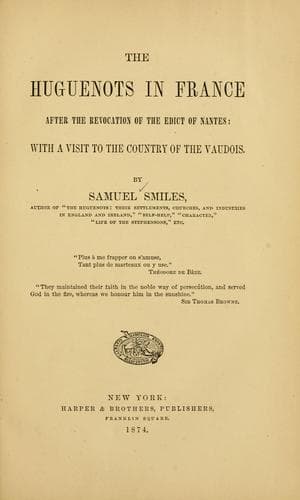
Dauphiné (France) -- Description and travel; Huguenots; Waldenses
Cavalier has set forth in his memoirs the details of the conditions
proposed by him, and which he alleges were afterwards duly agreed to
and signed by Villars and Baville, on the 17th of May, 1704, on the
part of the King. The first condition was liberty of conscience, with
the privilege of holding religious assemblies in country places. This
was agreed to, subject to the Protestant temples not being rebuilt.
The second--that all Protestants in prison or at the galleys should be
set at liberty within six weeks from the date of the treaty--was also
agreed to. The third--that all who had left the kingdom on account of
their religion should have liberty to return, and be restored to their
estates and privileges--was agreed to, subject to their taking the
oath of allegiance. The fourth--as to the re-establishment of the
parliament of Languedoc on its ancient footing--was promised
consideration. The fifth and sixth--that the province should be free
from capitation tax for ten years, and that the Protestants should
hold Montpellier, Cette, Perpignan, and Aiguesmortes, as cautionary
towns--were refused. The seventh--that those inhabitants of the
Cevennes whose houses had been burnt during the civil war should pay
no imposts for seven years--was granted. And the eighth--that Cavalier
should raise a regiment of dragoons to serve the King in Portugal--was
also granted.
These conditions are said to have been agreed to on the distinct
understanding that the insurrection should forthwith cease, and that
all persons in arms against the King should lay them down and submit
themselves to his majesty's clemency.
The terms having been generally agreed to, Cavalier respectfully took
his leave of the marshal, and returned to his comrades at the gate.
But Catinat and the Camisard guard had disappeared. The conference had
lasted two hours, during which Cavalier's general of horse had become
tired of waiting, and gone with his companions to refresh himself at
the sign of the Golden Cup. On his way thither, he witched the world
of Nismes with his noble horsemanship, making his charger bound and
prance and curvet, greatly to the delight of the immense crowd that
followed him.
On the return of the Camisard guard to the Récollets, Cavalier mounted
his horse, and, escorted by them, proceeded to the Hôtel de la Poste,
where he rested. In the evening, he came out on the Esplanade, and
walked freely amidst the crowd, amongst whom were many ladies, eager
to see the Camisard hero, and happy if they could but hear him speak,
or touch his dress. He then went to visit the mother of Daniel, his
favourite prophet, a native of Nismes, whose father and brother were
both prisoners because of their religion. Returning to the hotel,
Cavalier mustered his guard, and set out for Calvisson, followed by
hundreds of people, singing together as they passed through the town
gate the 133rd Psalm--"Behold, how good and how pleasant it is for
brethren to dwell together in unity!"
Public-domain text, read in full here on John Shaqi.
Reviews
Reviews
No reviews yet
Be the first to share your thoughts on this work.
Elsewhere in the archive
Join the Discussion
Join the discussion
Sign in to leave a comment or review.
Sign InorCreate an account