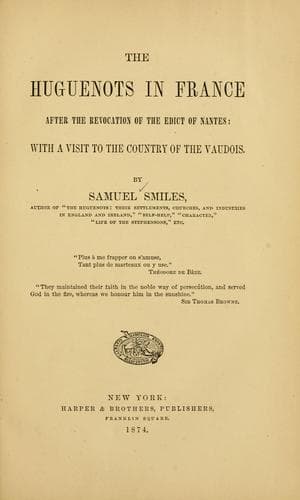
Dauphiné (France) -- Description and travel; Huguenots; Waldenses
It is not necessary further to pursue the history of Cavalier.
Suffice it to say that, at the request of Marshal Villars, he
proceeded to Paris, where he had an unsatisfactory interview with
Louis XIV.; that fearing an intention on the part of the Roman
Catholic party to make him a prisoner, he fled across the frontier
into Switzerland; that he eventually reached England, and entered the
English army, with the rank of Colonel; that he raised a regiment of
refugee Frenchmen, consisting principally of his Camisard followers,
at the head of whom he fought most valiantly at the battle of Almanza;
that he was afterwards appointed governor of Jersey, and died a
major-general in the British service in the year 1740, greatly
respected by all who knew him.
* * * * *
Although Cavalier failed in carrying the treaty into effect, so far as
he was concerned, his secession at this juncture proved a deathblow to
the insurrection. The remaining Camisard leaders endeavoured in vain
to incite that enthusiasm amongst their followers which had so often
before led them to victory. The men felt that they were fighting
without hope, and as it were with halters round their necks. Many of
them began to think that Cavalier had been justified in seeking to
secure the best terms practicable; and they dropped off, by tens and
fifties, to join their former leader, whose head-quarters for some
time continued to be at Vallabergue, an island in the Rhône a little
above Beaucaire.
The insurgents were also in a great measure disarmed by Marshal
Villars, who continued to pursue a policy of clemency, and at the same
time of severity. He offered a free pardon to all who surrendered
themselves, but threatened death to all who continued to resist the
royal troops. In sign of his clemency, he ordered the gibbets which
had for some years stood _en permanence_ in all the villages of the
Cevennes, to be removed; and he went from town to town, urging all
well-disposed people, of both religions, to co-operate with him in
putting an end to the dreadful civil war that had so long desolated
the province.
Moved by the marshal's eloquent appeals, the principal towns along the
Gardon and the Vidourle appointed deputies to proceed in a body to the
camp of Roland, and induce him if possible to accept the proffered
amnesty. They waited upon him accordingly at his camp of St. Felix and
told him their errand. But his answer was to order them at once to
leave the place on pain of death.
Villars himself sent messengers to Roland--amongst others the Baron
d'Aigalliers--offering to guarantee that no one should be molested on
account of his religion, provided he and his men would lay down their
arms; but Roland remained inflexible--nothing short of complete
religious liberty would induce him to surrender.
Public-domain text, read in full here on John Shaqi.
Reviews
Reviews
No reviews yet
Be the first to share your thoughts on this work.
Elsewhere in the archive
Join the Discussion
Join the discussion
Sign in to leave a comment or review.
Sign InorCreate an account