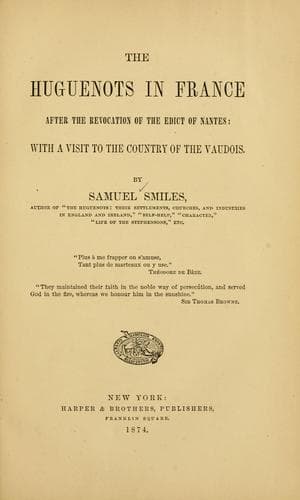
Dauphiné (France) -- Description and travel; Huguenots; Waldenses
The last to perish were Abraham and Joany. The one was shot while
holding the royal troops at bay, firing upon them from the roof of a
cottage at Mas-de-Couteau; the other was captured in the mountains
near the source of the Tarn. He was on his way to prison, tied behind
a trooper, like Rob Roy in Scott's novel, when, suddenly freeing
himself from his bonds while crossing the bridge of Pont-de-Montvert,
he slid from the horse, and leapt over the parapet into the Tarn. The
soldiers at once opened fire upon the fugitive, and he fell, pierced
with many balls, and was carried away in the torrent. And thus
Pont-de-Montvert, which had seen the beginning, also saw the end of
the insurrection.
CHAPTER IX.
GALLEY-SLAVES FOR THE FAITH.
After the death of the last of the Camisard leaders, there was no
further effort at revolt. The Huguenots seemed to be entirely put
down, and Protestantism completely destroyed. There was no longer any
resistance nor protest. If there were any Huguenots who had not become
Catholics, they remained mute. Force had at last succeeded in stifling
them.
A profound quiet reigned for a time throughout France. The country had
become a circle, closely watched by armed men--by dragoons, infantry,
archers, and coastguards--beyond which the Huguenots could not escape
without running the risk of the prison, the galley, or the gibbet.
The intendants throughout the kingdom flattered Louis XIV., and Louis
XIV. flattered himself, that the Huguenots had either been converted,
extirpated, or expelled the kingdom. The King had medals struck,
announcing the "_extinction of heresy_." A proclamation to this effect
was also published by the King, dated the 8th of March, 1715,
declaring the entire conversion of the French Huguenots, and
sentencing those who, after that date, relapsed from Catholicism to
Protestantism, to all the penalties of heresy.
What, then, had become of the Huguenots? They were for the moment
prostrate, but their life had not gone out of them. Many were no doubt
"converted." They had not strength to resist the pains and penalties
threatened by the State if they refused. They accordingly attended
Mass, and assisted in ceremonies which at heart they detested. Though
they blushed at their apostasy, they were too much broken down and
weary of oppression and suffering to attempt to be free.
Public-domain text, read in full here on John Shaqi.
Reviews
Reviews
No reviews yet
Be the first to share your thoughts on this work.
Elsewhere in the archive
Join the Discussion
Join the discussion
Sign in to leave a comment or review.
Sign InorCreate an account