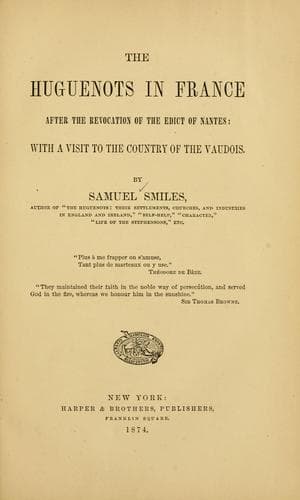
Dauphiné (France) -- Description and travel; Huguenots; Waldenses
Very different was the position of the young man who tried to undo all
that Louis XIV., under the influence of his mistress De Maintenon, and
his Jesuit confessor, Père la Chase,[52] had been trying all his life
to accomplish. He was an intelligent youth, the son of Huguenot
parents in Viverais, of comparatively poor and humble condition. He
was, however, full of energy, activity, and a zealous disposition for
work. Observing the tendency which Protestantism had, while bereft of
its pastors, to run into gloomy forms of fanaticism, Antoine Court
conceived the idea of reviving the pastorate, and restoring the
proscribed Protestant Church of France. It was a bold idea, but the
result proved that Antoine Court was justified in entertaining it.
[Footnote 52: Amongst the many satires and epigrams with
which Louis XIV. was pursued to the grave, the following
epitaph may be given:--
"Ci gist le mari de Thérèse
De la Montespan le Mignon,
L'esclave de la Maintenon,
Le valet du père La Chaise."
At the death of Louis XIV., Voltaire, an _élève_ of the
Jesuits, was appropriately coming into notice. At the age of
about twenty he was thrown into the Bastille; for having
written a satire on Louis XIV., of which the following is an
extract:--
"J'ai vu sous l'habit d'une femme
Un démon nous donner la loi;
Elle sacrifia son Dieu, sa foi, son âme,
Pour séduire l'esprit d'un trop crédule roi.
* * * * *
J'ai vu l'hypocrite honoré:
J'ai vu, c'est dire tout, le jésuite adoré:
J'ai vu ces maux sous le règne funeste
D'un prince que jadis la colère céleste
Accorda, par vengeance, à nos désirs ardens:
J'ai vu ces maux, et je n'ai pas vingt ans."
Voltaire denied having written this satire.]
Louis XIV. died in August, 1715. During that very month, Court
summoned together a small number of Huguenots to consider his
suggestions. The meeting was held at daybreak, in an empty quarry near
Nismes, which has already been mentioned in the course of this
history. But it may here be necessary to inform the reader of the
early life of this enthusiastic young man.
Antoine Court was born at Villeneuve de Berg, in Viverais, in the year
1696. Religious persecution was then at its height; assemblies were
vigorously put down; and all pastors taken prisoners were hanged on
the Peyrou at Montpellier. Court was only four years old when his
father died, and his mother resolved, if the boy lived, to train him
up so that he might consecrate himself to the service of God. He was
still very young while the Camisard war was in progress, but he heard
a great deal about it, and vividly remembered all that he heard.
Public-domain text, read in full here on John Shaqi.
Reviews
Reviews
No reviews yet
Be the first to share your thoughts on this work.
Elsewhere in the archive
Join the Discussion
Join the discussion
Sign in to leave a comment or review.
Sign InorCreate an account