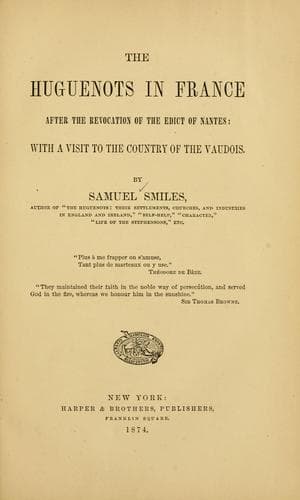
Dauphiné (France) -- Description and travel; Huguenots; Waldenses
As he grew older, he at length determined to devote his life to
preaching and ministering to the forsaken and afflicted Protestants.
It was a noble, self-denying work, the only earthly reward for which
was labour, difficulty, and danger. His mother was in great trouble,
for Antoine was her only remaining son. She did not, however, press
him to change his resolution. Court quoted to her the text, "Whoever
loves father and mother more than me, is not worthy of me." After
this, she only saw in her son a victim consecrated, like another
Abraham, to the Divine service.
After arriving at his decision, Court proceeded to visit the Huguenots
in Low Languedoc, passing by Uzes to Nismes, and preaching wherever he
could draw assemblies of the people together. His success during this
rapid excursion induced him to visit Dauphiny. There he met Brunel,
another preacher, with knapsack on his back, running from place to
place in order to avoid spies, priests, and soldiers. The two were
equally full of ardour, and they went together preaching in many
places, and duly encouraging each other.
From Dauphiny, Court directed his steps to Marseilles, where the royal
galleys stationed there contained about three hundred Huguenot
galley-slaves. He penetrated these horrible floating prisons, without
being detected, and even contrived to organize amongst them a regular
system of secret worship. Then he returned to Nismes, and from thence
went through the Cevennes and the Viverais, preaching to people who
had never met for Protestant worship since the termination of the wars
of the Camisards. To elude the spies, who began to make hot search for
him, because of the enthusiasm which he excited, Court contrived to be
always on the move, and to appear daily in some fresh locality.
The constant fatigue which he underwent undermined his health, and he
was compelled to remain for a time inactive at the mineral waters of
Euzet. This retirement proved useful. He began to think over what
might be done to revivify the Protestant religion in France. Remember
that he was at that time only nineteen years of age! It might be
thought presumptuous in a youth, comparatively uninstructed, even to
dream of such a subject. The instruments of earthly power--King, Pope,
bishops, priests, soldiers, and spies--were all arrayed against him.
He had nothing to oppose to them but truth, uprightness, conscience,
and indefatigable zeal for labour.
When Court had last met the few Protestant preachers who survived in
Languedoc, they were very undecided about taking up his scheme. They
had met at Nismes to take the sacrament in the house of a friend.
There were Bombonnoux (an old Camisard), Crotte, Corteiz, Brunel, and
Court. Without coming to any decision, they separated, some going to
Switzerland, and others to the South and West of France. It now rested
with Court, during his sickness, to study and endeavour to arrange the
method of reorganization of the Church.
Public-domain text, read in full here on John Shaqi.
Reviews
Reviews
No reviews yet
Be the first to share your thoughts on this work.
Elsewhere in the archive
Join the Discussion
Join the discussion
Sign in to leave a comment or review.
Sign InorCreate an account