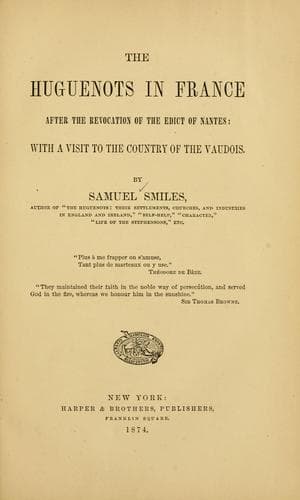
Dauphiné (France) -- Description and travel; Huguenots; Waldenses
It usually began with the seizing and burning of books. The
book-burning days were considered amongst the great days of fête.
One day in June, 1730, the Intendant of Languedoc visited Nismes,
escorted by four battalions of troops. On arriving, the principal
Catholics were selected, and placed as commissaries to watch the
houses of the suspected Huguenots. At night, while the inhabitants
slept, the troops turned out, and the commissaries pointed out the
Huguenot houses to be searched. The inmates were knocked up, the
soldiers entered, the houses were rummaged, and all the books that
could be found were taken to the Hôtel de Ville.
A few days after a great _auto-da-fé_ was held. The entire Catholic
population turned out. There were the four battalions of troops, the
gendarmes, the Catholic priests, and the chief dignitaries; and in
their presence all the Huguenot books were destroyed. They were thrown
into a pile on the usual place of execution, and the hangman set fire
to this great mass of Bibles, psalm-books, catechisms, and
sermons.[59] The officers laughed, the priests sneered, the multitude
cheered. These bonfires were of frequent occurrence in all the towns
of Languedoc.
[Footnote 59: E. Hughes, "Histoire de la Restauration, du
Protestantisme en France," ii. 96.]
But if the priests hated the printed word, still more did they hate
the spoken word. They did not like the Bible, but they hated the
preachers. Fines, _auto-da-fés_, condemnation to the galleys, seizures
of women and girls, and profanation of the dead, were tolerable
punishments, but there was nothing like hanging a preacher. "Nothing,"
said Saint-Florentin to the commandant of La Devese, "can produce more
impression than hanging a preacher; and it is very desirable that you
should immediately take steps to arrest one of them."
The commandant obeyed orders, and apprehended Pierre Durand. He was on
his way to baptize the child of one of his congregation, who lived on
a farm in Viverais. An apparent peasant, who seemed to be waiting his
approach, offered to conduct him to the farm. Durand followed him. The
peasant proved to be a soldier in disguise. He led Durand directly
into the midst of his troop. There he was bound and carried off to
Montpellier.
Durand was executed at the old place--the Peyrou--the soldiers
beating their drums to stifle his voice while he prayed. His corpse
was laid beside that of Alexandre Roussel, under the rampart of the
fortress of Montpellier. Durand was the last of the preachers in
France who had attended the synod of 1715. They had all been executed,
excepting only Antoine Court, who was safe in Switzerland.
Public-domain text, read in full here on John Shaqi.
Reviews
Reviews
No reviews yet
Be the first to share your thoughts on this work.
Elsewhere in the archive
Join the Discussion
Join the discussion
Sign in to leave a comment or review.
Sign InorCreate an account