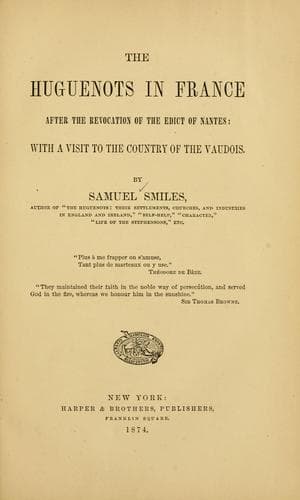
Dauphiné (France) -- Description and travel; Huguenots; Waldenses
While the King indulged in his vicious pleasures, and went reeking
from his debaucheries to obtain absolution from his confessors, the
persecution of the Protestants went on as before. Nor was it until
public opinion (such as it was) was brought to bear upon the hideous
incongruity that religious persecutions were at once brought summarily
to an end.
The last executions of Huguenots in France because of their
Protestantism occurred in 1762. Francis Rochette, a young pastor,
twenty-six years old, was laid up by sickness at Montauban. He
recovered sufficiently to proceed to the waters of St. Antonin for the
recovery of his health, when he was seized, together with his two
guides or bearers, by the burgess guard of the town of Caussade. The
three brothers Grenier endeavoured to intercede for them; but the
mayor of Caussade, proud of his capture, sent the whole of the
prisoners to gaol.
They were tried by the judges of Toulouse on the 18th of February.
Rochette was condemned to be hung in his shirt, his head and feet
uncovered, with a paper pinned on his shirt before and behind, with
the words written thereon--"_Ministre de la religion prétendue
réformée._" The three brothers Grenier, who interfered on behalf of
Rochette, were ordered to have their heads taken off for resisting the
secular power; and the two guides, who were bearing the sick Rochette
to St. Antonin for the benefit of the waters, were sent to the galleys
for life.
Barbarous punishments such as these were so common when Protestants
were the offenders, that the decision, of the judges did not excite
any particular sensation. It was only when Jean Calas was shortly
after executed at Toulouse that an extraordinary sensation was
produced--and that not because Calas was a Protestant, but because his
punishment came under the notice of Voltaire, who exposed the inhuman
cruelty to France, Europe, and the world at large.
The reason why Protestant executions terminated with the death of
Calas was as follows:--The family of Jean Calas resided at Toulouse,
then one of the most bigoted cities in France. Toulouse swarmed with
priests and monks, more Spanish than French in their leanings. They
were great in relics, processions, and confraternities. While
"mealy-mouthed" Catholics in other quarters were becoming somewhat
ashamed of the murders perpetrated during the Massacre of St.
Bartholomew, and were even disposed to deny them, the more outspoken
Catholics of Toulouse were even proud of the feat, and publicly
celebrated the great southern Massacre of St. Bartholomew which took
place in 1572. The procession then held was one of the finest church
commemorations in the south; it was followed by bishops, clergy, and
the people of the neighbourhood, in immense numbers.
Public-domain text, read in full here on John Shaqi.
Reviews
Reviews
No reviews yet
Be the first to share your thoughts on this work.
Elsewhere in the archive
Join the Discussion
Join the discussion
Sign in to leave a comment or review.
Sign InorCreate an account