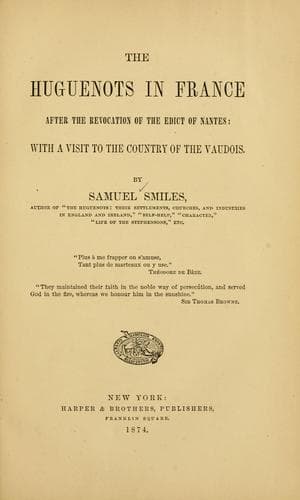
Dauphiné (France) -- Description and travel; Huguenots; Waldenses
Amongst these, Jean Fabre, a young silk merchant of Nismes, was
already beyond reach of danger, when he heard that his father had been
made a prisoner. The old man, who was seventy-eight, could not climb
as the others had done, and the soldiers had taken him and were
leading him away. The son, who knew that his father would be sentenced
to the galleys for life, immediately determined, if possible, to
rescue him from this horrible fate. He returned to the group of
soldiers who had his father in charge, and asked them to take him
prisoner in his place. On their refusal, he seized his father and drew
him from their grasp, insisting upon them taking himself instead. The
sergeant in command at first refused to adopt this strange
substitution; but, conquered at last by the tears and prayers of the
son, he liberated the aged man and accepted Jean Fabre as his
prisoner.
Jean Fabre was first imprisoned at Nismes, where he was prevented
seeing any of his friends, including a certain young lady to whom he
was about shortly to be married. He was then transferred to
Montpellier to be judged; where, of course, he was condemned, as he
expected, to be sent to the galleys for life. With this dreadful
prospect before him, of separation from all that he loved--from his
father, for whom he was about to suffer so much; from his betrothed,
who gave up all hope of ever seeing him again--and having no prospect
of being relieved from his horrible destiny, his spirits failed, and
he became seriously ill. But his youth and Christian resignation came
to his aid, and he finally recovered.
The Protestants of Nismes, and indeed of all Languedoc, were greatly
moved by the fate of Jean Fabre. The heroism of his devotion to his
parent soon became known, and the name of the volunteer convict was
in every mouth. The Duc de Mirepoix, then governor of the province,
endeavoured to turn the popular feeling to some account. He offered
pardon to Fabre and Turgis (who had been taken prisoner with him)
provided Paul Rabaut, the chief pastor of the Desert, a hard-working
and indefatigable man, would leave France and reside abroad. But
neither Fabre, nor Rabaut, nor the Huguenots generally, had any
confidence in the mercy of the Catholics, and the proposal was coldly
declined.
Public-domain text, read in full here on John Shaqi.
Reviews
Reviews
No reviews yet
Be the first to share your thoughts on this work.
Elsewhere in the archive
Join the Discussion
Join the discussion
Sign in to leave a comment or review.
Sign InorCreate an account