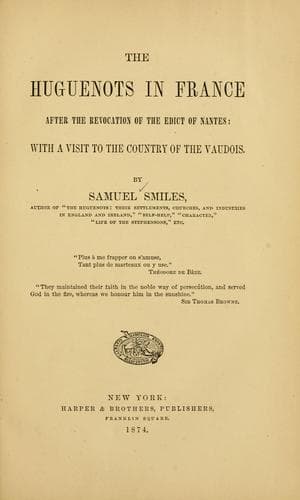
Dauphiné (France) -- Description and travel; Huguenots; Waldenses
It is probable that her noble decision determined Fabre and Fabre's
friends to make a renewed effort for his liberation. At last, after
having been more than six years a galley-slave, he bethought him of a
method of obtaining at least a temporary liberty. He proposed--without
appealing to Saint-Florentin, who was the bitter enemy of the
Protestants--to get his case made known to the Duc de Choiseul,
Minister of Marine. This nobleman was a just man, and it had been in a
great measure through his influence that the judgment of Calas had
been reconsidered and reversed.
Fabre, while on the rowers' bench, had often met with a M. Johannot, a
French Protestant, settled at Frankfort-on-Maine, to whom he stated
his case. It may be mentioned that Huguenot refugees, on their visits
to France, often visited the Protestant prisoners at the galleys,
relieved their wants, and made intercession for them with the outside
world. It may also be incidentally mentioned that this M. Johannot was
the ancestor of two well-known painters and designers, Alfred and
Tony, who have been the illustrators of some of our finest artistic
works.
Johannot made the case of Fabre known to some French officers whom he
met at Frankfort, interested them greatly in his noble character and
self-sacrifice, and the result was that before long Fabre obtained,
directly from the Duc de Choiseul, leave of absence from the position
of galley-slave. The annoyance of Saint-Florentin, Minister of State,
was so well-known, that Fabre, on his liberation, was induced to
conceal himself. Nor could he yet marry his promised wife, as he had
not been discharged, but was only on leave of absence; and
Saint-Florentin obstinately refused to reverse the sentence that had
been pronounced against him.
In the meantime, Fabre's name was becoming celebrated. He had no idea,
while privately settled at Ganges as a silk stocking maker, that great
people in France were interesting themselves about his fate. The
Duchesse de Grammont, sister of the Duc de Choiseul, had heard about
him from her brother; and the Prince de Beauvau, governor of
Languedoc, the Duchesse de Villeroy, and many other distinguished
personages, were celebrating his heroism.
Inquiry was made of the sergeant who had originally apprehended Fabre,
upon his offering himself in exchange for his father (long since
dead), and the sergeant confirmed the truth of the noble and generous
act. At the same time, M. Alison, first consul at Nismes, confirmed
the statement by three witnesses, in presence of the secretary of the
Prince de Beauvau. The result was, that Jean Fabre was completely
exonerated from the charge on account of which he had been sent to the
galleys. He was now a free man, and at last married the young lady who
had loved him so long and so devotedly.
Public-domain text, read in full here on John Shaqi.
Reviews
Reviews
No reviews yet
Be the first to share your thoughts on this work.
Elsewhere in the archive
Join the Discussion
Join the discussion
Sign in to leave a comment or review.
Sign InorCreate an account