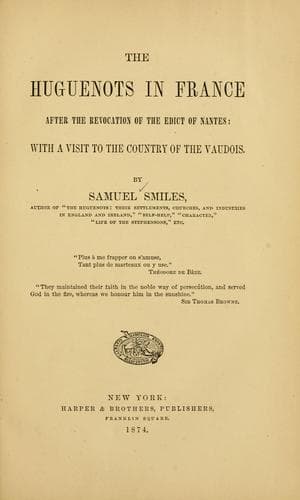
Dauphiné (France) -- Description and travel; Huguenots; Waldenses
The whole army of France was let loose upon the Huguenots. They had
been beaten out of Holland by the Dutch Calvinists; and they could now
fearlessly take their revenge out of their unarmed Huguenot
fellow-countrymen. Whenever they quartered themselves in a dwelling,
it was, for the time being, their own. They rummaged the cellars,
drank the wines, ordered the best of everything, pillaged the house,
and treated everybody who belonged to it as a slave. The Huguenots
were not only compelled to provide for the entertainment of their
guests, but to pay them their wages. The superior officers were paid
fifteen francs a day, the lieutenants nine francs, and the common
soldiers three francs. If the money was not paid, the household
furniture, the horses and cows, and all the other articles that could
be seized, were publicly sold.
No wonder that so many Huguenots were "converted" by the dragoons.
Forty thousand persons were converted in Poitou. The regiment of
Asfeld was the instrument of their conversion. A company and a half of
dragoons occupied the house of a single lady at Poitiers until she was
converted to the Roman Catholic faith. What bravery!
The Huguenots of Languedoc were amongst the most obstinate of all.
They refused to be converted by the priests; and then Louis XIV.
determined to dragonnade them. About sixty thousand troops were
concentrated on the province. Noailles, the governor, shortly after
wrote to the King that he had converted the city of Nismes in
twenty-four hours. Twenty thousand converts had been made in
Montauban; and he promised that by the end of the month there would be
no more Huguenots left in Languedoc.
Many persons were doubtless converted by force, or by the fear of
being dragonnaded; but there were also many more who were ready to run
all risks rather than abjure their faith. Of those who abjured, the
greater number took the first opportunity of flying from France, by
land or by sea, and taking refuge in Switzerland, Germany, Holland, or
England. Many instances might be given of the heroic fortitude with
which the Huguenots bore the brutality of their enemies; but, for the
present, it may be sufficient to mention the case of the De Péchels of
Montauban.
The citizens of Montauban had been terribly treated before and after
the Revocation of the Edict of Nantes. The town had been one of the
principal Huguenot places of refuge in France. Hence its population
was principally Protestant. Its university had been shut up. Its
churches had been levelled to the ground. Its professors and pastors
had been banished from France. And now it was to be dragonnaded.
Public-domain text, read in full here on John Shaqi.
Reviews
Reviews
No reviews yet
Be the first to share your thoughts on this work.
Elsewhere in the archive
Join the Discussion
Join the discussion
Sign in to leave a comment or review.
Sign InorCreate an account