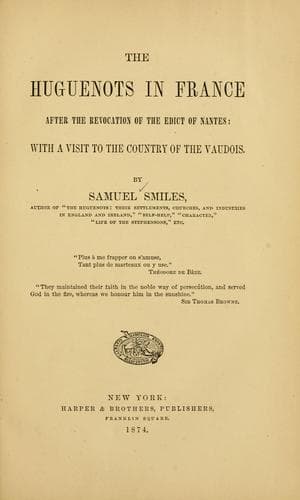
Dauphiné (France) -- Description and travel; Huguenots; Waldenses
The weather had now become cold, dreary, and rainy. Provisions were
scarcely to be had. The people of Dundalk were themselves starving.
Strong bodies of cavalry foraged the country, but were able to find
next to nothing in the shape of food for themselves, or corn for their
horses. The ships from England, laden with provisions which ought to
have arrived at Belfast, were forced back by contrary winds. Thus the
army was becoming rapidly famished. Disease soon made its appearance,
and carried off the men by hundreds. Schomberg's camp, outside
Dundalk, was situated by the side of a marsh--a most unwholesome
position; but the marsh protected him from the enemy, who were not far
off. The rain and snow continued; the men and the horses were
perpetually drenched; and scouring winds blew across the camp. Ague,
dysentery, and fever everywhere prevailed. Dalrymple has recorded that
of fifteen thousand men who belonged to Schomberg's army, not less
than eight thousand perished. Under these circumstances, the greatly
reduced force broke up from their cantonments and went into winter
quarters. Schomberg's cavalry regiment was stationed at Lurgan, then a
small village, which happily had not been burnt. De Péchels was one of
those who had been sick in camp, and was disabled from pursuing the
campaign further. After remaining for some weeks at Lurgan, he
obtained leave from the Duke of Schomberg to return to London. And
there, after the lapse of four years, he found and embraced his
beloved and noble wife.
De Péchels continued invalided, and was unable to rejoin the army of
King William. "After some stay in London," he says, in the memoir from
which the above extracts are made, "it was the King's pleasure to
exempt from further service certain officers specified by name, and to
assign them a pension. Through a kind Providence I was included in the
number. When I had lived in London on the pension which it had pleased
the king to allow those officers who were no longer in a position to
serve him, until the 1st of August, 1692, I then left that city, in
company with my wife and son, to remove into Ireland, whither my
pension was transferred."
De Péchels accordingly arrived in Dublin, where he spent the rest of
his days in peace and quiet. He lived to experience the truth of the
promise "that every one that hath forsaken houses, or brethren, or
sisters, or father, or mother, or wife, or children, or lands for my
name's sake, shall receive an hundredfold, and shall inherit
everlasting life." De Péchels died in 1732, at a ripe old age, in his
eighty-seventh year, and was interred in the Huguenot cemetery in the
neighbourhood of Dublin.
Public-domain text, read in full here on John Shaqi.
Reviews
Reviews
No reviews yet
Be the first to share your thoughts on this work.
Elsewhere in the archive
Join the Discussion
Join the discussion
Sign in to leave a comment or review.
Sign InorCreate an account