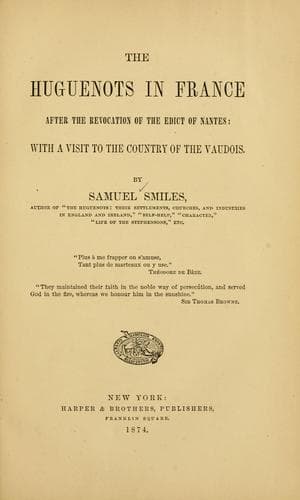
Dauphiné (France) -- Description and travel; Huguenots; Waldenses
The account given by Rapin of James's departure from England is
somewhat ludicrous. The Queen went first. On the night between the 9th
and 10th of December she crossed the Thames in disguise. She waited
under the walls of a church at Lambeth until a coach could be got
ready for her at the nearest inn. She went from thence to Gravesend,
where she embarked with the Prince of Wales on a small vessel, which
conveyed them safely to France. The King set out on the following
night. He entered a small boat at Whitehall, dressed in a plain suit
and a bob wig, accompanied by a few friends. He threw the Great Seal
into the water, from whence it was afterwards dragged up by a
fisherman's net. Before he left, he gave the Earl of Feversham orders
to disband the army without pay, in order, probably, to create anarchy
after his flight.
James reached the south shore of the Thames. He travelled, with relays
of horses, to Emley Ferry, near the Island of Sheppey. He went on
board the little vessel that was to convey him to a French frigate
lying in the mouth of the Thames ready to transport him to France. The
wind blew strong, and the vessel was unable to sail.
The fishermen of the neighbourhood boarded the vessel in which the
King was. They took him for the chaplain of Sir Edward Hales, one of
his attendants. They searched the King, and found upon him four
hundred guineas and several valuable seals and jewels, which they
seized. A constable was present who knew the King, and he ordered
restitution of the valuables which had been taken from him. The King
wished to be gone, but the people by a sort of violence conducted him
to a public inn in the town of Feversham. He then sent for the Earl of
Winchelsea, Lord-Lieutenant of the county, who prevailed upon him not
to leave the kingdom, but to return to London.
And to London he went. The Prince of Orange was by this time at
Windsor. On the King's arrival in London he was received with
acclamations, as if he had returned from victory. He resumed
possession of his palace. He published a proclamation, announcing that
having been given to understand that divers outrages had been
committed in various parts of the kingdom, by burning, pulling down,
and defacing of houses, he commanded all lord-lieutenants, &c., to
prevent such outrages for the future, and suppress all riotous
assemblies.
This was his last public act. He was without an army. He had few
friends. The Dutch Guards arrived in London, and took possession of
St. James's and Whitehall. The Prince of Orange sent three lords to
the King to desire his Majesty's departure for Ham--a house belonging
to the Duchess of Lauderdale; but the King desired them to tell the
Prince that he wished rather to go to Rochester. The Prince gave his
consent.
Public-domain text, read in full here on John Shaqi.
Reviews
Reviews
No reviews yet
Be the first to share your thoughts on this work.
Elsewhere in the archive
Join the Discussion
Join the discussion
Sign in to leave a comment or review.
Sign InorCreate an account