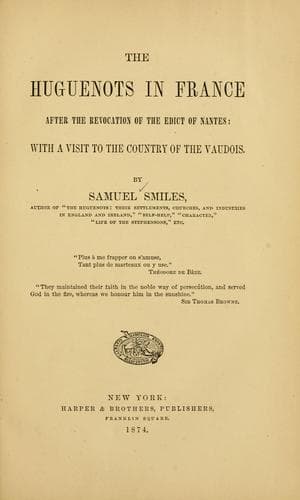
Dauphiné (France) -- Description and travel; Huguenots; Waldenses
About the end of September, King James's army approached the lines of
Dundalk. They drew up in order of battle. The English officers were
for attacking the enemy, but Schomberg advised them to refrain. A
large party of horse appeared within cannon shot, but they made no
further attempt. In a day or two after James drew off his army to
Ardee, Count Rosen indignantly exclaiming, "If your Majesty had ten
kingdoms, you would lose them all." In the meantime, Schomberg
remained entrenched in his camp. The Enniskilleners nevertheless made
various excursions, and routed a body of James's troops marching
towards Sligo.
Great distress fell upon Schomberg's army. The marshy land on which
they were encamped, the wet and drizzly weather, the scarcity and
badness of the food, caused a raging sickness to break out. Great
numbers were swept away by disease. Among the officers who died were
Sir Edward Deering, of Kent; Colonel Wharton, son of Lord Wharton; Sir
Thomas Gower and Colonel Hungerford, two young gentlemen of
distinguished merit. Two thousand soldiers died in the camp. Many
afterwards perished from cold and hunger. Schomberg at length left the
camp at Dundalk, and the remains of his army went into winter
quarters.
Rapin shared all the suffering of the campaign. When the army
retreated northward, Rapin was sent with a party of soldiers to occupy
a fortified place between Stranorlar and Donegal. It commanded the
Pass of Barnes Gap. This is perhaps the most magnificent defile in
Ireland. It is about four miles long. Huge mountains rise on either
side. The fortalice occupied by Rapin is now in ruins. It stands on a
height overlooking the northern end of the pass. It is now called
Barrack Hill. The Rapparees who lived at the lower end of the Gap were
accustomed to come down upon the farming population of the lowland
country on the banks of the rivers Finn and Mourne, and carry off all
the cattle that they could seize; Rapin was accordingly sent with a
body of troops to defend the lowland farmers from the Rapparees.
Besides, it was found necessary to defend the pass against the forces
of King James, who then occupied Sligo and the neighbouring towns,
under the command of General Sarsfield.
Public-domain text, read in full here on John Shaqi.
Reviews
Reviews
No reviews yet
Be the first to share your thoughts on this work.
Elsewhere in the archive
Join the Discussion
Join the discussion
Sign in to leave a comment or review.
Sign InorCreate an account