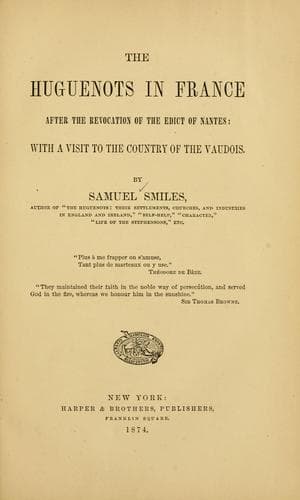
Dauphiné (France) -- Description and travel; Huguenots; Waldenses
The enemy, seeing the discomfiture of the King's party, and that he
rode away wounded, spread abroad the news that he was killed. "They
immediately," says Rapin, "set up a shout all over their camp, and
drew down several squadrons of their horse upon a plain towards the
river, as if they meant to pass and pursue the English army. Nay, the
report of the King's death flew presently to Dublin, and from thence
spread as far as Paris, where the people were encouraged to express
their joy by bonfires and illuminations." In the meantime William
returned to his tent, where he had his wound dressed, and again
mounted and showed himself to the whole army, in order to dissipate
their apprehensions. He remained on horseback until nine at night,
though he had been up since one o'clock in the morning.
William then called a council of war, and declared his resolution of
forcing the river next day. Schomberg opposed this, but finding the
King determined, he urged that a strong body of horse and foot should
be sent to Slane bridge that night, so as to be able to cross the
bridge and get between the enemy and the Pass of Duleek, which lay
behind King James's army. This advice, if followed, might perhaps have
ended the war in one campaign. Such is Rapin's opinion. The proposal
was, however, rejected; and it was determined to cross the river in
force on the following morning. William inspected the troops at
midnight. He rode along the whole army by torchlight, and after giving
out the password "Westminster," he returned to his tent for a few
hours' sleep.
The shades of night lay still over that sleeping host. The stars
looked down in peace on these sixty thousand brethren of the same
human family, ready to rise with the sun and imbrue their hands in
each other's blood. Tyrannical factions and warring creeds had set
them at enmity with each other, and turned the sweetness and joy of
their nature into gall and bitterness. The night was quiet. The murmur
of the river fell faintly on the ear. A few trembling lights gleamed
through the dark from the distant watchtowers of Drogheda. The only
sounds that rose from the vast host that lay encamped in the valley of
the Boyne were the challenges of the sentinels to each other as they
paced their midnight rounds.
The sun rose clear and beautiful. It was the first day of July--a day
for ever memorable in the history of Ireland as well as England. The
_générale_ was beat in the camp of William before daybreak, and as
soon as the sun was up the battle began. Lieutenant-General Douglas
marched towards the right with six battalions of foot, accompanied by
Count Schomberg (son of the Marshal) with twenty-four squadrons of
horse. They crossed the river below the bridge of Slane, and though
opposed by the Irish, they drove them back and pressed them on towards
Duleek.
Public-domain text, read in full here on John Shaqi.
Reviews
Reviews
No reviews yet
Be the first to share your thoughts on this work.
Elsewhere in the archive
Join the Discussion
Join the discussion
Sign in to leave a comment or review.
Sign InorCreate an account