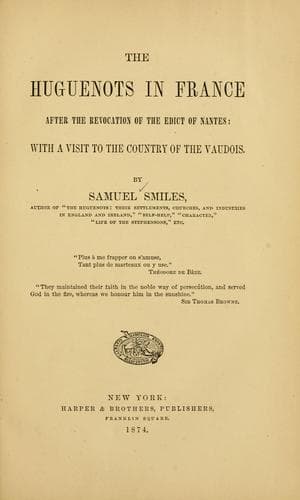
Dauphiné (France) -- Description and travel; Huguenots; Waldenses
Rapin entered Athlone with his regiment, and conducted himself with
his usual valour. Ginckel remained only a few days in the place, in
order to repair the fortifications. That done, he set out in pursuit
of the enemy. He left two regiments in the castle, one of which was
that to which Rapin belonged. The soldiers, who belonged to different
nationalities, had many contentions with each other. The officers
stood upon their order of precedence. The men were disposed to
quarrel. Aided by a friend, a captain like himself, Rapin endeavoured
to pacify the men, and to bring the officers to reason. By his kind,
gentle, and conciliatory manner, he soon succeeded in restoring quiet
and mutual confidence; and during his stay at Athlone no further
disturbance occurred among the garrison.
Rapin was ordered to Kilkenny, where he had a similar opportunity of
displaying his qualities of conciliation. A quarrel had sprung up
between the chief magistrate of the town and the officers of the
garrison. Rapin interceded, and by his firmness and moderation he
reconciled all differences; and, at the same time, he gained the
respect and admiration of both the disputing parties.
By this time the second siege of Limerick had occurred. Ginckel
surrounded the city, and battered the walls and fortresses for six
weeks. The French and Irish armies at length surrendered. Fourteen
thousand Irish marched out with the honours of war. A large proportion
of them joined the army of Louis XIV., and were long after known as
"The Irish Brigade." Although they fought valiantly and honourably in
many well-known battles, they were first employed in Louis'
persecution of the Protestants in the Vaudois and Cevennes mountains.
Their first encounter was with the Camisards, under Cavalier, their
peasant leader. They gained no glory in that campaign, but a good deal
of discredit.
In the meantime Ireland had been restored to peace. After the
surrender of Limerick no further resistance was offered to the arms of
William III. A considerable body of English troops remained in Ireland
to garrison the fortresses. Rapin's regiment was stationed at Kinsale,
and there he rejoined it in 1693. He made the intimate friendship of
Sir James Waller, the governor of the town. Sir James was a man of
much intelligence, a keen observer, and an ardent student. By his
knowledge of political history, he inspired Rapin with a like taste,
and determined him at a later period in his life to undertake what was
a real want at the time, an intelligent and readable history of
England.
Public-domain text, read in full here on John Shaqi.
Reviews
Reviews
No reviews yet
Be the first to share your thoughts on this work.
Elsewhere in the archive
Join the Discussion
Join the discussion
Sign in to leave a comment or review.
Sign InorCreate an account