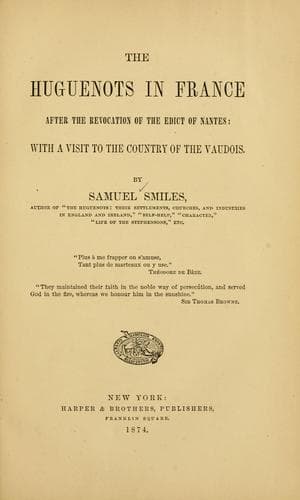
Dauphiné (France) -- Description and travel; Huguenots; Waldenses
It was while in Italy that the Earl of Portland, at the instigation of
Rapin, requested copies to be made for him of the rarest and most
precious medals in point of historic interest; and also to purchase
for him objects of ancient workmanship. Hence Rapin was able to secure
for him the _Portland Vase_, now in the British Museum, one of the
most exquisite products of Roman and Etruscan ceramic art.
In 1699, the Earl of Portland was sent by William III. as ambassador
to the court of Louis XIV., in connection with the negotiations as to
the Spanish succession. Lord Woodstock attended the embassy, and Rapin
accompanied him. They were entertained at Versailles. Persecution was
still going on in France, although about eight hundred thousand
persons had already left the country. Rapin at one time thought of
leaving Lord Woodstock for a few days, and making a rapid journey
south to visit his friends near Toulouse. But the thought of being
made a prisoner and sent to the galleys for life stayed him, and he
remained at Versailles until the return of the embassy.
Rapin remained with Lord Woodstock for thirteen years. In the meantime
he had married, at the Hague, Marie Anne Testart, a refugee from
Saint-Quentin. Jean Rou describes her as a true helpmeet for him,
young, beautiful, rich, and withal virtuous, and of the most pleasing
and gentle temper in the world. Her riches, however, were not great.
She had merely, like Rapin, rescued some portion of her heritage from
the devouring claws of her persecutors. Rapin accumulated very little
capital during his tutorship of Lord Woodstock; but to compensate him,
the King granted him a pension of £100 a year, payable by the States
of Holland, until he could secure some better income.
Rapin lived for some time at the Hague. While there he joined a
society of learned French refugees. Among them were Rotolf de la
Denèse, Basnage de Beauval, and Jean Rou, secretary to the
States-General. One of the objects of the little academy was to
translate the Psalms anew into French verse; but before the version
was completed, Rapin was under the necessity of leaving the Hague.
William III., his patron, died in 1701, when his pension was stopped.
He was promised some remunerative employment, but he was forgotten
amidst the press of applicants.
Public-domain text, read in full here on John Shaqi.
Reviews
Reviews
No reviews yet
Be the first to share your thoughts on this work.
Elsewhere in the archive
Join the Discussion
Join the discussion
Sign in to leave a comment or review.
Sign InorCreate an account