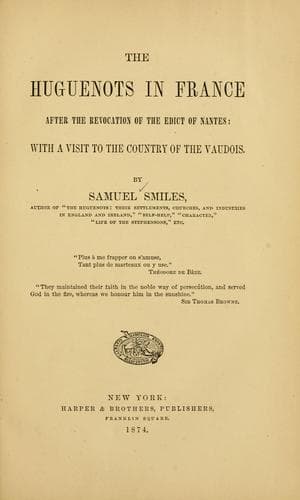
Dauphiné (France) -- Description and travel; Huguenots; Waldenses
Early in the evening of the 1st of April the signal to prepare for
action was made; and Lord Nelson, with Riou and Foley, on board the
_Elephant_--all the other officers having returned to their
respective ships--arranged the order of battle on the following day.
What remains to be told of Riou is matter of history. The science and
skill in navigation which made Nelson intrust to him the last
soundings, and place under his command the fire-ships which were to
lead the way on the following morning,--the gallantry with which the
captain of the _Amazon_ throw himself, _impar congressus_, under the
fearful fire of the Trekroner battery, to redeem the failure
threatened by the grounding of the ships of the line,--have all been
told with a skilful pen, and forms a picture of a great sailor's last
hours, which is cherished with equal pride in the affections of his
family and the annals of his country.
Sir Hyde Parker's signal to "leave off action," which Nelson, putting
his telescope to his blind eye, refused to see, was seen, by Riou and
reluctantly obeyed. Indeed, nothing but that signal for retreat saved
the _Amazon_ from destruction, though it did not save its heroic
commander. As he unwillingly drew off from the destructive fire of the
battery he mournfully exclaimed, "What will Nelson think of us!" His
clerk had been killed by his side. He himself had been wounded in the
head by a splinter, but continued to sit on a gun encouraging his men,
who were falling in numbers around him. "Come then, my boys," he
cried, "let us all die together." Scarcely had he uttered the words,
when a raking shot cut him in two. And thus, in an instant, perished
the "gallant good Riou," at the early age of thirty-nine.
Riou was a man of the truest and tenderest feelings, yet the bravest
of the brave. His private correspondence revealed the most endearing
qualities of mind and heart, while the nobility of his actions was
heightened by lofty Christian sentiment, and a firm reliance on the
power and mercy of God. His chivalrous devotion to duty in the face of
difficulty and danger heightened the affectionate admiration with
which he was regarded, and his death before Copenhagen was mourned
almost as a national bereavement. The monument erected to his memory
in St. Paul's Cathedral represented, however inadequately, the widely
felt sorrow which pervaded all classes at the early death of this
heroic officer. "Except it had been Nelson himself," says Southey,
"the British navy could not have suffered a severer loss."
Public-domain text, read in full here on John Shaqi.
Reviews
Reviews
No reviews yet
Be the first to share your thoughts on this work.
Elsewhere in the archive
Join the Discussion
Join the discussion
Sign in to leave a comment or review.
Sign InorCreate an account