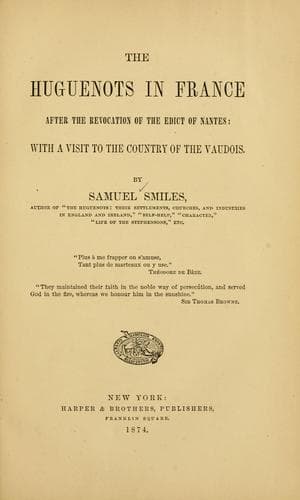
Dauphiné (France) -- Description and travel; Huguenots; Waldenses
[Footnote 100: An authorised account was prepared by Cardinal
Wiseman for English readers, entitled "Manual of the
Association of our Lady of Reconciliation of La Salette," and
published as a tract by Burns, 17, Portman Street, in 1853.
Since I passed through the country in 1869, the Germans have
invaded France, the surrender has occurred at Sedan, the
Commune has been defeated at Paris, but Our Lady of La
Salette is greater than ever. A temple of enormous dimensions
has risen in her honour; the pilgrims number over 100,000
yearly, and the sale of the water from the Holy Well, said to
have sprung from the Virgin's tears, realises more than
£12,000. Since the success of La Salette, the Virgin has been
making repeated appearances in France. Her last appearance
was in a part of Alsace which is strictly Catholic. The
Virgin appeared, as usual, to a boy of the mature age of six,
"dressed in black, floating in the air, her hands bound with
chains,"--a pretty strong religio-political hint. When a
party of the 5th Bavarian Cavalry was posted in Bettweiler,
the Virgin ceased to make her appearance.]
* * * * *
As a pendant to this story, another may be given of an entirely
different character, relating to the inhabitants of another commune in
the same valley, about midway between La Salette and Grenoble. In
1860, while the discussion about the miracle at La Salette was still
in progress, the inhabitants of Notre-Dame-de-Comiers, dissatisfied
with the conduct of their curé, invited M. Fermaud, pastor of the
Protestant church at Grenoble, to come over and preach to them, as
they were desirous of embracing Protestantism. The pastor, supposing
that they were influenced by merely temporary irritation against their
curé, cautioned the deputation that waited upon him as to the gravity
of their decision in such a matter, and asked them to reflect further
upon it.
For several years M. Fermaud continued to maintain the same attitude,
until, in 1865, a formal petition was delivered to him by the mayor of
the place, signed by forty-three heads of families, and by nine out of
the ten members of the council of the commune, urging him to send them
over a minister of the evangelical religion. Even then he hesitated,
and recommended the memorialists to appeal to the bishop of the
diocese for redress of the wrongs of which he knew they complained,
but in vain, until at length, in the beginning of 1868, with the
sanction of the consistory of Grenoble a minister was sent over to
Comiers to perform the first acts of Protestant worship, including
baptism and marriage; and it was not until October in the same year
that Pastor Fermaud himself went thither to administer the sacrament
to the new church.
Public-domain text, read in full here on John Shaqi.
Reviews
Reviews
No reviews yet
Be the first to share your thoughts on this work.
Elsewhere in the archive
Join the Discussion
Join the discussion
Sign in to leave a comment or review.
Sign InorCreate an account