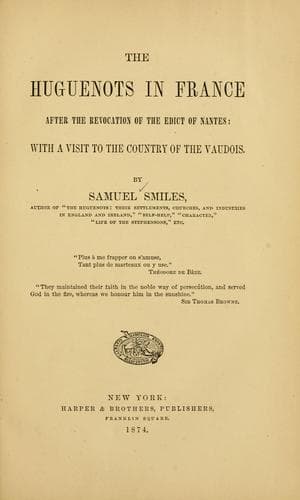
Dauphiné (France) -- Description and travel; Huguenots; Waldenses
After resting some two hours at La Grave, we proceeded by the two
tunnels under the hamlet of Ventelong--one of which is 650 and the
other 1,800 feet long--to the village of Villard d'Arene, which,
though some five thousand feet above the level of the sea, is so
surrounded by lofty mountains that for months together the sun never
shines on it. From thence a gradual ascent leads up to the summit of
the Col de Lauteret, which divides the valley of the Romanche from
that of the Guisanne. The pastures along the mountain-side are of the
richest verdure; and so many rare and beautiful plants are found
growing there that M. Rousillon has described it as a "very botanical
Eden." Here Jean Jacques Rousseau delighted to herborize, and here the
celebrated botanist Mathonnet, originally a customs officer, born at
the haggard village of Villard d'Arene, which we have just passed,
cultivated his taste for natural history, and laid the foundations of
his European reputation. The variety of temperature which exists along
the mountain-side, from the bottom to the summit, its exposure to the
full rays of the sun in some places, and its sheltered aspect in
others, facilitate the growth of an extraordinary variety of beautiful
plants and wild flowers. In the low grounds meridional plants
flourish; on the middle slopes those of genial climates; while on the
summit are found specimens of the flora of Lapland and Greenland. Thus
almost every variety of flowers is represented in this brilliant
natural garden--orchids, cruciferæ, leguminæ, rosaceæ, caryophyllæ,
lilies of various kinds, saxifrages, anemones, ranunculuses, swertia,
primula, varieties of the sedum, some of which are peculiar to this
mountain, and are elsewhere unknown.
After passing the Hospice near the summit of the Col, the valley of
the Guisanne comes in sight, showing a line of bare and rugged
mountains on the right hand and on the left, with a narrow strip of
land in the bottom, in many parts strewn with stones carried down by
the avalanches from the cliffs above. Shortly we come in sight of the
distant ramparts of Briançon, apparently closing in the valley, the
snow-clad peak of Monte Viso rising in the distance. Halfway between
the Col and Briançon we pass through the village of Monestier, where,
being a saint's day, the bulk of the population are in the street,
holding festival. The place was originally a Roman station, and the
people still give indications of their origin, being extremely
swarthy, black-haired, and large-eyed, evidently much more Italian
than French.
Public-domain text, read in full here on John Shaqi.
Reviews
Reviews
No reviews yet
Be the first to share your thoughts on this work.
Elsewhere in the archive
Join the Discussion
Join the discussion
Sign in to leave a comment or review.
Sign InorCreate an account