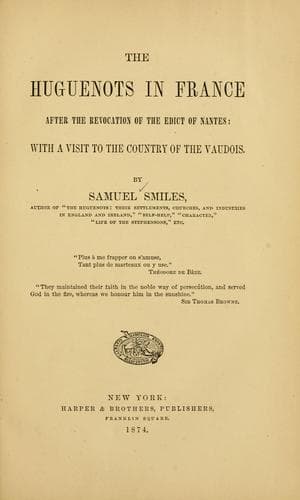
Dauphiné (France) -- Description and travel; Huguenots; Waldenses
The fortress of Briançon, which we entered by a narrow winding roadway
round the western rampart, is the frontier fortress which guards the
pass from Italy into France by the road over Mont Genèvre. It must
always have been a strong place by nature, overlooking as it does the
valley of the Durance on the one hand, and the mountain road from
Italy on the other, while the river Clairée, running in a deep defile,
cuts it off from the high ground to the south and east. The highest
part of the town is the citadel, or Fort du Château, built upon a peak
of rock on the site of the ancient castle. It was doubtless the
nucleus round which the early town became clustered, until it filled
the lower plateau to the verge of the walls and battlements. There
being no room for the town to expand, the houses are closely packed
together and squeezed up, as it were, so as to occupy the smallest
possible space. The streets are narrow, dark, gloomy, and steep, being
altogether impassable for carriages. The liveliest sight in the place
is a stream of pure water, that rushes down an open conduit in the
middle of the principal street, which is exceedingly steep and narrow.
The town is sacrificed to the fortifications, which dominate
everywhere. With the increasing range and power of cannon, they have
been extended in all directions, until they occupy the flanks of the
adjoining mountains and many of their summits, so that the original
castle now forms but a comparatively insignificant part of the
fortress. The most important part of the population is the
soldiery--the red-trousered missionaries of "civilisation," according
to the gospel of Louis Napoleon, published a short time before our
visit.
Public-domain text, read in full here on John Shaqi.
Reviews
Reviews
No reviews yet
Be the first to share your thoughts on this work.
Elsewhere in the archive
Join the Discussion
Join the discussion
Sign in to leave a comment or review.
Sign InorCreate an account