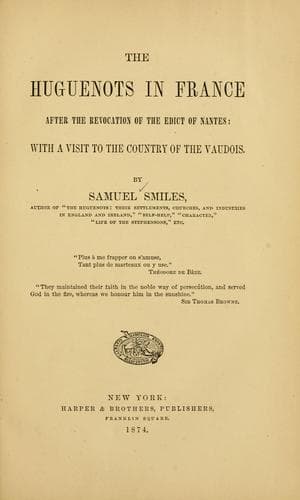
Dauphiné (France) -- Description and travel; Huguenots; Waldenses
In Languedoc, in Dauphiny, and in the southern provinces generally,
men and women who professed Protestantism were liable to be hanged or
sent to the galleys, down to nearly the end of the last century. A
Protestant pastor who exercised his vocation did so at the daily peril
of his life. Nothing in the shape of a Protestant congregation was
permitted to exist, and if Protestants worshipped together, it was in
secret, in caves, in woods, among the hills, or in the "Desert." Yet
Protestantism nevertheless contrived to exist through this long dark
period of persecution, and even to increase. And when at length it
became tolerated, towards the close of the last century, the numbers
of its adherents appeared surprising to those who had imagined it to
be altogether extinct.
Indeed, looking at the persistent efforts made by Louis XIV. to
exterminate the Huguenots, and to the fact that many hundred thousand
of the best of them emigrated into foreign countries, while an equal
number are supposed to have perished in prison, on the scaffold, at
the galleys, and in their attempts to escape, it may almost be
regarded as matter of wonder that the Église Reformée--the Church of
the old Huguenots--should at the present day number about a thousand
congregations, besides the five hundred Lutheran congregations of
Alsatia, and that the Protestants of France should amount, in the
whole, to about two millions of souls.
CHAPTER III.
VAL LOUISE--HISTORY OF FELIX NEFF.
Some eight miles south of Briançon, on the road to Fort Dauphin, a
little river called the Gyronde comes down from the glaciers of Mont
Pelvoux, and falls into the Durance nearly opposite the village of La
Bessie. This river flows through Val Louise, the entrance into which
can be discerned towards the northwest. Near the junction of the
rivers, the ruins of an embattled wall, with entrenchments, are
observed extending across the valley of the Durance, a little below
the narrow pass called the "Pertuis-Rostan," evidently designed to
close it against an army advancing from the south. The country people
still call those ruins the "Walls of the Vaudois;"[101] and according
to tradition a great Vaudois battle was fought there; but of any such
battle history makes no mention.
[Footnote 101: A gap in the mountain-wall to the left, nearly
over La Bessie, is still known as "La Porte de Hannibal,"
through which, it is conjectured, that general led his army.
But opinion, which is much divided as to the route he took,
is more generally in favour of his marching up the Isère, and
passing into Italy by the Little St. Bernard.]
Public-domain text, read in full here on John Shaqi.
Reviews
Reviews
No reviews yet
Be the first to share your thoughts on this work.
Elsewhere in the archive
Join the Discussion
Join the discussion
Sign in to leave a comment or review.
Sign InorCreate an account