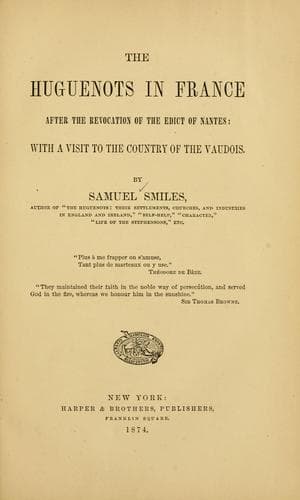
Dauphiné (France) -- Description and travel; Huguenots; Waldenses
His defence was of no avail. He was condemned to be racked, then to be
broken on the wheel, and afterwards to be executed. He received the
sentence without a shudder. He was tied on the rack, but when he
refused to accuse his brethren he was released from it. Attempts were
made by several priests and friars to add him to the number of "new
converts," but these were altogether fruitless. All that remained was
to execute him finally on the public place of execution--the Peyrou.
The Peyrou is the pride of modern Montpellier. It is the favourite
promenade of the place, and is one of the finest in Europe. It
consists of a broad platform elevated high above the rest of the town,
and commanding extensive views of the surrounding country. In clear
weather, Mont Ventoux, one of the Alpine summits, may be seen across
the broad valley of the Rhône on the east, and the peak of Mont
Canizou in the Pyrenees on the west. Northward stretches the mountain
range of the Cevennes, the bold Pic de Saint-Loup the advanced
sentinel of the group; while in the south the prospect is bounded by
the blue line of the Mediterranean.
The Peyrou is now pleasantly laid out in terraced walks and shady
groves, with gay parterres of flowers--the upper platform being
surrounded with a handsome stone balustrade. An equestrian statue of
Louis XIV. occupies the centre of the area; and a triumphal arch
stands at the entrance to the promenade, erected to commemorate the
"glories" of the same monarch, more particularly the Revocation by him
of the Edict of Nantes--one of the entablatures of the arch displaying
a hideous figure, intended to represent a Huguenot, lying trampled
under foot of the "Most Christian King."
The Peyrou was thus laid out and ornamented in the reign of his
successor, Louis XV., "the Well-beloved," during which the same policy
for which Louis XIV. was here glorified by an equestrian statue and a
triumphal arch continued to be persevered in--of imprisoning,
banishing, hanging, or sending to the galleys such of the citizens of
France as were not of "the King's religion."
But during the reign of Louis XIV. himself, the Peyrou was anything
but a pleasure-ground. It was the infamous place of the city--the
_place de Grève_--a desert, barren, blasted table-land, where
sometimes half-a-dozen decaying corpses might be seen swinging from
the gibbets on which they had been hung. It was specially reserved,
because of its infamy, for the execution of heretics against Rome; and
here, accordingly, hundreds of Huguenot martyrs--whom power, honour,
and wealth failed to bribe or to convert--were called upon to seal
their faith with their blood.
Public-domain text, read in full here on John Shaqi.
Reviews
Reviews
No reviews yet
Be the first to share your thoughts on this work.
Elsewhere in the archive
Join the Discussion
Join the discussion
Sign in to leave a comment or review.
Sign InorCreate an account