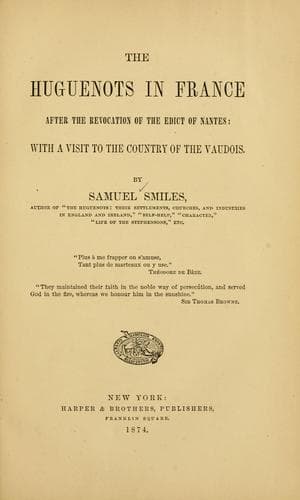
Dauphiné (France) -- Description and travel; Huguenots; Waldenses
Although the arbitrary measures of the King were felt all over France,
they nowhere excited more dismay and consternation than in the
province of Languedoc. This province had always been inhabited by a
spirited and energetic people, born lovers of liberty. They were among
the earliest to call in question the despotic authority over mind and
conscience claimed by the see of Rome. The country is sown with the
ashes of martyrs. Long before the execution of Brousson, the Peyrou at
Montpellier had been the Calvary of the South of France.
As early as the twelfth century, the Albigenses, who inhabited the
district, excited the wrath of the Popes. Simple, sincere believers in
the Divine providence, they rejected Rome, and took their stand upon
the individual responsibility of man to God. Count de Foix said to the
legate of Innocent III.: "As to my religion, the Pope has nothing to
do with it. Every man's conscience must be free. My father has always
recommended to me this liberty, and I am content to die for it."
A crusade was waged against the Albigenses, which lasted for a period
of about sixty years. Armies were concentrated upon Languedoc, and
after great slaughter the heretics were supposed to be exterminated.
But enough of the people survived to perpetuate the love of liberty in
their descendants, who continued to exercise a degree of independence
in matters of religion and politics almost unknown in other parts of
France. Languedoc was the principal stronghold of the Huguenots in the
sixteenth and seventeenth centuries; and when, in 1685, Louis XIV.
revoked the Edict of Nantes, which interdicted freedom of worship
under penalty of confiscation, banishment, and death, it is not
surprising that such a policy should have occasioned widespread
consternation, if not hostility and open resistance.
At the period of the Revocation there were, according to the Intendant
of the province, not fewer than 250,000 Protestants in Languedoc, and
these formed the most skilled, industrious, enterprising, and wealthy
portion of the community. They were the best farmers, vine-dressers,
manufacturers, and traders. The valley of Vaunage, lying to the
westward of Nismes, was one of the richest and most highly cultivated
parts of France. It contained more than sixty temples, its population
being almost exclusively Protestant; and it was known as "The Little
Canaan," abounding as it did in corn, and wine, and oil.
The greater part of the commerce of the South of France was conducted
by the Protestant merchants of Nismes, of whom the Intendant wrote to
the King in 1699, "If they are still bad Catholics, at any rate they
have not ceased to be very good traders."
The Marquis d'Aguesseau bore similar testimony to the intelligent
industry of the Huguenot population. "By an unfortunate fatality,"
said he, "in nearly every kind of art the most skilful workmen, as
well as the richest merchants, belong to the pretended reformed
religion."
Public-domain text, read in full here on John Shaqi.
Reviews
Reviews
No reviews yet
Be the first to share your thoughts on this work.
Elsewhere in the archive
Join the Discussion
Join the discussion
Sign in to leave a comment or review.
Sign InorCreate an account