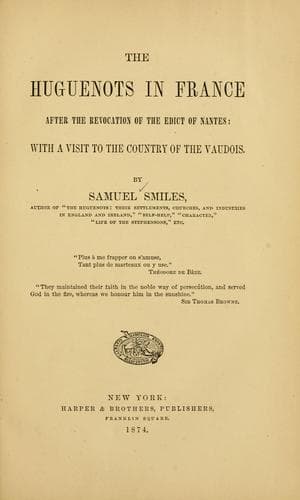
Dauphiné (France) -- Description and travel; Huguenots; Waldenses
The whole of this mountain district maybe regarded as a triangular
plateau rising gradually from the northwest, and tilted up at its
south-eastern angle. It is composed for the most part of granite,
overlapped by strata belonging to the Jurassic-system; and in many
places, especially in Auvergne, the granitic rocks have been burst
through by volcanoes, long since extinct, which rise like enormous
protuberances from the higher parts of the platform. Towards the
southern border of the district, the limestone strata overlapping the
granite assume a remarkable development, exhibiting a series of
flat-topped hills bounded by perpendicular cliffs some six or eight
hundred feet high.
"These plateaux," says Mr. Scrope, in his interesting account of the
geology of Central France, "are called 'causses' in the provincial
dialect, and they have a singularly dreary and desert aspect from the
monotony of their form and their barren and rocky character. The
valleys which separate them are rarely of considerable width. Winding,
narrow, and all but impassable cliff-like glens predominate, giving to
the Cevennes that peculiarly intricate character which enabled its
Protestant inhabitants, in the beginning of the last century, to offer
so stubborn and gallant a resistance to the atrocious persecutions of
Louis XIV."
Such being the character of this mountain district--rocky, elevated,
and sterile--the people inhabiting it, though exceedingly industrious,
are for the most very poor. Sheep-farming is the principal occupation
of the people of the hill country; and in the summer season, when the
lower districts are parched with drought, tens of thousands of sheep
may be seen covering the roads leading to the Upper Cevennes, whither
they are driven for pasture. There is a comparatively small breadth of
arable land in the district. The mountains in many places contain only
soil enough to grow juniper-bushes. There is very little verdure to
relieve the eye--few turf-clad slopes or earth-covered ledges to
repay the tillage of the farmer. Even the mountains of lower elevation
are for the most part stony deserts. Chestnut-trees, it is true, grow
luxuriantly in the sheltered places, and occasionally scanty crops of
rye on the lower mountain-sides. Mulberry-trees also thrive in the
valleys, their leaves being used for the feeding of silkworms, the
rearing of which forms one of the principal industries of the
district.
Public-domain text, read in full here on John Shaqi.
Reviews
Reviews
No reviews yet
Be the first to share your thoughts on this work.
Elsewhere in the archive
Join the Discussion
Join the discussion
Sign in to leave a comment or review.
Sign InorCreate an account