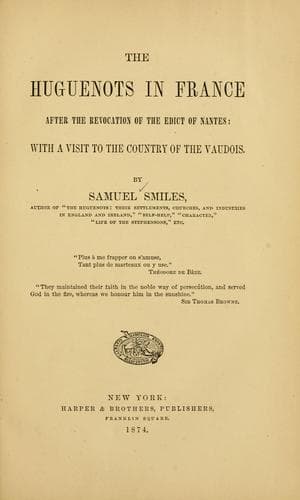
Dauphiné (France) -- Description and travel; Huguenots; Waldenses
Such was the end of Laporte, the second leader of the Camisards.
Seguier, the first, had been chief for only six days; Laporte, the
second, for only about two months. Again Baville supposed the
pacification of the Cevennes to be complete. He imagined that Poul, in
cutting off Laporte's head, had decapitated the insurrection. But the
Camisard ranks had never been so full as now, swelled as they were by
the persecutions of the Royalists, who, by demolishing the homes of
the peasantry, had in a measure forced them into the arms of the
insurgents. Nor were they ever better supplied with leaders, even
though Laporte had fallen. No sooner did his death become known, than
the "Children of God" held a solemn assembly in the mountains, at
which Roland, Castanet, Salomon, Abraham, and young Cavalier were
present; and after lamenting the death of their chief, they with one
accord elected Laporte's nephew, Roland, as his successor.
* * * * *
A few words as to the associates of Roland, whose family and origin
have already been described. André Castanet of Massavaque, in the
Upper Cevennes, had been a goatherd in his youth, after which he
worked at his father's trade of a wool-carder. An avowed Huguenot, he
was, shortly after the peace of Ryswick, hunted out of the country
because of his attending the meetings in the Desert; but in 1700 he
returned to preach and to prophesy, acting also as a forest-ranger in
the Aigoal Mountains. Of all the chiefs he was the greatest
controversialist, and in his capacity of preacher he distinguished
himself from his companions by wearing a wig. There must have been
something comical in his appearance, for Brueys describes him as a
little, squat, bandy-legged man, presenting "the figure of a little
bear." But it was an enemy who drew the picture.
Next there was Salomon Conderc, also a wool-carder, a native of the
hamlet of Mazelrode, south of the mountain of Bougès. For twenty years
the Condercs, father and son, had been zealous worshippers in the
Desert--Salomon having acted by turns as Bible-reader, precentor,
preacher, and prophet. We have already referred to the gift of
prophesying. All the leaders of the Camisards were prophets. Elie
Marion, in his "Théâtre Sacré de Cevennes," thus describes the
influence of the prophets on the Camisard War:--
Public-domain text, read in full here on John Shaqi.
Reviews
Reviews
No reviews yet
Be the first to share your thoughts on this work.
Elsewhere in the archive
Join the Discussion
Join the discussion
Sign in to leave a comment or review.
Sign InorCreate an account