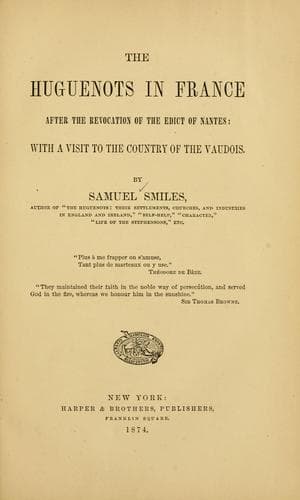
Dauphiné (France) -- Description and travel; Huguenots; Waldenses
Being virtually an outlaw, Cavalier afterwards joined the band of
Laporte, under whom he served as lieutenant during his short career.
At his death the insurrection assumed larger proportions, and recruits
flocked apace to the standard of Roland, Laporte's successor.
Harvest-work over, the youths of the Lower Cevennes hastened to join
him, armed only with bills and hatchets. The people of the Vaunage
more than fulfilled their promise to Roland, and sent him five hundred
men. Cavalier also brought with him from Ribaute a further number of
recruits, and by the end of autumn the Camisards under arms, such as
they were, amounted to over a thousand men.
Roland, unable to provide quarters or commissariat for so large a
number, divided them into five bodies, and sent them into their
respective cantonments (so to speak) for the winter. Roland himself
occupied the district known as the Lower Cevennes, comprising the
Gardonnenque and the mountain district situated between the rivers
Vidourle and the western Gardon. That part of the Upper Cevennes,
which extends between the Anduze branch of the Gardon and the river
Tarn, was in like manner occupied by a force commanded by Abraham
Hazel and Solomon Conderc, while Andrew Castanet led the people of the
western Cevennes, comprising the mountain region of the Aigoal and the
Esperou, near the sources of the Gardon d'Anduze and the Tarnon. The
rugged mountain district of the Lozère, in which the Tarn, the Ceze,
and the Alais branch of the Gardon have their origin, was placed under
the command of Joany. And, finally, the more open country towards the
south, extending from Anduze to the sea-coast, including the districts
around Alais, Uzes, Nismes, as well as the populous valley of the
Vaunage, was placed under the direction of young Cavalier, though he
had scarcely yet completed his seventeenth year.
These chiefs were all elected by their followers, who chose them, not
because of any military ability they might possess, but entirely
because of their "gifts" as preachers and "prophets." Though Roland
and Joany had been soldiers, they were also preachers, as were
Castanet, Abraham, and Salomon; and young Cavalier had already given
remarkable indications of the prophetic gift. Hence, when it became
the duty of the band to which he belonged to select a chief, they
passed over the old soldiers, Espérandieu, Raslet, Catinat, and
Ravenel, and pitched upon the young baker lad of Ribaute, not because
he could fight, but because he could preach; and the old soldiers
cheerfully submitted themselves to his leadership.
The portrait of this remarkable Camisard chief represents him as a
little handsome youth, fair and ruddy complexioned, with lively and
prominent blue eyes, and a large head, from whence his long fair hair
hung floating over his shoulders. His companions recognised in him a
supposed striking resemblance to the scriptural portrait of David, the
famous shepherd of Israel.
Public-domain text, read in full here on John Shaqi.
Reviews
Reviews
No reviews yet
Be the first to share your thoughts on this work.
Elsewhere in the archive
Join the Discussion
Join the discussion
Sign in to leave a comment or review.
Sign InorCreate an account