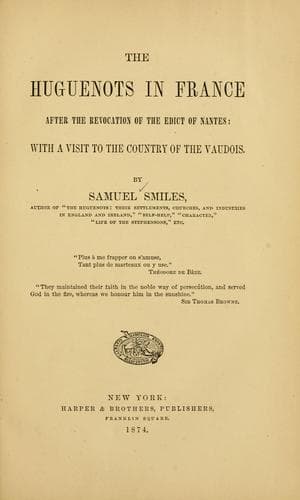
Dauphiné (France) -- Description and travel; Huguenots; Waldenses
A few miles up the valley, the little hamlet of Massoubeyran,
consisting of a group of peasant cottages--one of which was the
birthplace of Roland, the Camisard chief--was seen on a hill-side to
the right; and about two miles further on, at a bend of the road, we
came in sight of the village of Mialet, with its whitewashed,
flat-roofed cottages--forming a little group of peasants' houses lying
in the hollow of the hills. The principal building in it is the
Protestant temple, which continues to be frequented by the
inhabitants; the _Annuaire Protestant_ for 1868-70, stating the
Protestant population of the district to be 1,325. Strange to say, the
present pastor, M. Seguier, bears the name of the first leader of the
Camisard insurrection; and one of the leading members of the
consistory, M. Laporte, is a lineal descendant of the second and third
leaders.
From its secluded and secure position among the hills, as well as
because of its proximity to the great Temelac road constructed by
Baville, which passed from Anduze by St. Jean-de-Gard into the Upper
Cevennes, Mialet was well situated as the head-quarters of the
Camisard chief. But it was principally because of the numerous
limestone caves abounding in the locality, which afforded a ready
hiding-place for the inhabitants in the event of the enemies'
approach, as well as because they were capable of being adapted for
the purpose of magazines, stores, and hospitals, that Mialet became of
so much importance as the citadel of the insurgents. One of such
caverns or grottoes is still to be seen about a mile below Mialet, of
extraordinary magnitude. It extends under the hill which rises up on
the right-hand side of the road, and is entered from behind, nearly
at the summit. The entrance is narrow and difficult, but the interior
is large and spacious, widening out in some places into dome-shaped
chambers, with stalactites hanging from the roof. The whole extent of
this cavern cannot be much less than a quarter of a mile, judging from
the time it took to explore it and to return from the furthest point
in the interior to the entrance. The existence of this place had been
forgotten until a few years ago, when it was rediscovered by a man of
Anduze, who succeeded in entering it, but, being unable to find his
way out, he remained there for three days without food, until the
alarm was given and his friends came to his rescue and delivered him.
Public-domain text, read in full here on John Shaqi.
Reviews
Reviews
No reviews yet
Be the first to share your thoughts on this work.
Elsewhere in the archive
Join the Discussion
Join the discussion
Sign in to leave a comment or review.
Sign InorCreate an account