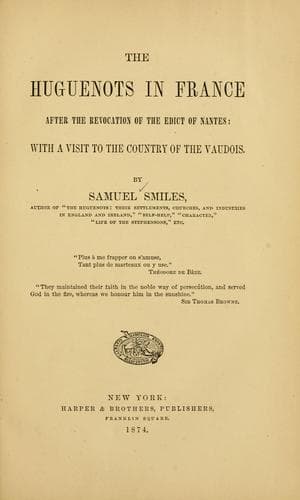
Dauphiné (France) -- Description and travel; Huguenots; Waldenses
The country in the neighbourhood of Nismes is by no means picturesque.
Though undulating, it is barren, arid, and stony. The view from the
Tour Magne, which is very extensive, is over an apparently skeleton
landscape, the bare rocks rising on all sides without any covering of
verdure. In summer the grass is parched and brown. There are few trees
visible; and these mostly mulberry, which, when, cropped, have a
blasted look. Yet, wherever soil exists, in the bottoms, the land is
very productive, yielding olives, grapes, and chestnuts in great
abundance.
As we ascend the valley of the Gardon, the country becomes more
undulating and better wooded. The villages and farmhouses have all an
old-fashioned look; not a modern villa is to be seen. We alight from
the train at the Ners station--Ners, where Cavalier drove Montrevel's
army across the river, and near which, at the village of Martinargues,
he completely defeated the Royalists under Lajonquière. We went to see
the scene of the battle, some three miles to the south-east, passing
through a well-tilled country, with the peasants busily at work in the
fields. From the high ground behind Ners a fine view is obtained of
the valley of the Gardon, overlooking the junction of its two branches
descending by Alais and Anduze, the mountains of the Cevennes rising
up in the distance. To the left is the fertile valley of Beaurivage,
celebrated in the Pastorals of Florian, who was a native of the
district.
Descending the hill towards Ners, we were overtaken by an aged peasant
of the village, with a scythe over his shoulder, returning from his
morning's work. There was the usual polite greeting and exchange of
salutations--for the French peasant is by nature polite--and a ready
opening was afforded for conversation. It turned out that the old man
had been a soldier of the first empire, and fought under Soult in the
desperate battle of Toulouse in 1814. He was now nearly eighty, but
was still able to do a fair day's work in the fields. Inviting us to
enter his dwelling and partake of his hospitality, he went down to his
cellar and fetched therefrom a jug of light sparkling wine, of which
we partook. In answer to an inquiry whether there were any Protestants
in the neighbourhood, the old man replied that Ners was "all
Protestant." His grandson, however, who was present, qualified this
sweeping statement by the remark, _sotto voce_, that many of them were
"nothing."
The conversation then turned upon the subject of Cavalier and his
exploits, when our entertainer launched out into a description of the
battle of Martinargues, in which the Royalists had been "toutes
abattus." Like most of the Protestant peasantry of the Cevennes, he
displayed a very familiar acquaintance with the events of the civil
war, and spoke with enthusiasm and honest pride of the achievements of
the Camisards.
* * * * *
Public-domain text, read in full here on John Shaqi.
Reviews
Reviews
No reviews yet
Be the first to share your thoughts on this work.
Elsewhere in the archive
Join the Discussion
Join the discussion
Sign in to leave a comment or review.
Sign InorCreate an account