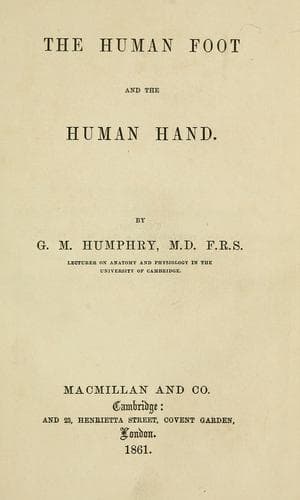
The human foot and the human handHumphry, George Murray, Sir
Science
The human foot and the human hand
Humphry, George Murray, Sir
Foot; Hand
In WRITING the pen should be held between the pulps of the fore and
middle fingers and the thumb, in contact with all three, and firmly
lodged between them. The down-stroke is made by bending the phalanges
of the fingers and the thumb inwards and the metacarpal bone of the
thumb outwards; and the up-stroke is made by straightening all the
joints of the fingers and thumb. The hand rests lightly, not upon its
whole edge, but, upon the hindermost and foremost parts of the edge,
that is, upon the pisiform bone of the wrist and upon the little finger
near the end, so that it can be moved easily along the paper, and can
be inclined, or rolled, a little to either side. The obliquity of the
stroke is not imposed by mere arbitrary rule, but is in accordance with
the direction in which there is the freest movement of the fingers and
thumb when thus holding the pen. Make the experiment for yourselves of
moving the pen in different directions, and you will soon be satisfied
that the writing-master has nature on his side in insisting on a
particular movement as well as a particular mode of holding the pen.
Some persons make the strokes vertical, or slope them the wrong way;
but in either case the writing is stiff and awkward; it is not natural.
The custom of writing from left to right may also be regarded as
correct or natural, inasmuch as we can move the pen more freely
upwards and _out_wards than upwards and _in_wards. Hence the light
_up_ or advancing stroke--that which connects a letter with the one
which follows it--is most easily made _out_wards or to the right;
and the letters are, consequently, made to follow one another in
that direction. To understand this more clearly make a down-stroke
upon paper in the usual manner; you will then find that you can make
up-strokes from any part of it more easily to the right than to the
left; and if you make a series of continuous up-and-down-strokes at
a little distance from one another, the up-stroke is, not merely
habitually, but naturally, made fine and inclined to the right, whereas
the down-stroke is made heavier or thicker and is sloped to the left.
Moreover, you will perceive that the hand slides along the paper more
easily from left to right than from right to left.
It is worthy of remark that the writing of all that great class of
languages called Indo-European, which includes Sanscrit, Greek, Latin,
and many others, with our own, is from left to right; whereas nearly
all the writing of another great class called the Semitic, which
includes the Hebrew and Arabic, is in the opposite direction, viz.
from right to left. Some nations write in perpendicular columns, the
letters being placed under one another, of which the Chinese affords an
example. But either of the two latter methods must be inferior to the
Indo-European style in ease of execution and expedition.
_Reason for the Ring being usually placed upon the Fourth finger._
Public-domain text, read in full here on John Shaqi.
Reviews
Reviews
No reviews yet
Be the first to share your thoughts on this work.
Elsewhere in the archive
Join the Discussion
Join the discussion
Sign in to leave a comment or review.
Sign InorCreate an account