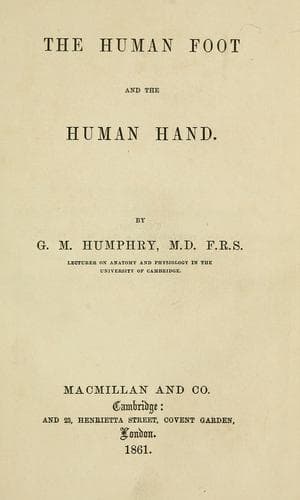
The human foot and the human handHumphry, George Murray, Sir
Science
The human foot and the human hand
Humphry, George Murray, Sir
Foot; Hand
A little in front of the root of the nail the ridges of the cutis
suddenly become larger and more vascular. This gives a pink hue to
the nail in the greater part of its extent; while the hinder portion,
separated from the front by a crescentic line, is white, in consequence
of the subjacent cutis being there, more pale. You will, at once,
recognise the distinction between these parts by looking at your own
nails.
The ridges and furrows serve, like the papillæ in other parts of the
skin, to increase the surface of the cutis; and, by affording more
space for the distribution of the vessels and nerves, they contribute
to the sensitiveness of the part, and account for the severe pain which
is caused when any foreign body is thrust under the nail. The pulp
in the interior of a tooth, and the frog of a horse’s foot, are also
instances in which an exquisitely sensitive structure is placed beneath
a hard or horny substance. The object, in each case, is the same, viz.
to give the power of taking cognizance of impressions which are made
upon the surface.
_Hairs._
HAIRS may also be regarded as modifications of the cuticle, because,
like the nails, they are continuous with the cuticle, and are formed
from the rete mucosum. Each hair (figs. 79 and 83) is received
into a depression of the cutis, which is called a “follicle,” and which
is lined, as far as the bottom, by cuticle (_a_), and rete mucosum
(_b_). At the bottom of the follicle (_d_) the cuticle is absent, and
the hair rests, directly, upon the rete; and, at this part, the rete,
instead of being converted into cuticle, as it is at the sides of the
follicle, becomes transformed into hair, in the following way.
[Illustration: Fig. 79. Hair.]
[Illustration: Fig. 80.]
[Illustration: Fig. 81.]
[Illustration: Fig. 82.]
The cells of which the rete is composed swell out as they ascend,
and so form the soft “bulb” of the hair. The outermost cells are
gradually flattened, and assume an imbricated arrangement, overlapping
one another like the tiles upon a roof (fig. 79, _e_, and
fig. 80); and those in the interior are elongated, so as to be
converted into more or less distinct fibres. The cells nearest the
middle, or axis, of the hair remain moister and softer than those
nearer the exterior, and form what is sometimes called the “marrow” of
the hair (figs. 81 and 82).
Public-domain text, read in full here on John Shaqi.
Reviews
Reviews
No reviews yet
Be the first to share your thoughts on this work.
Elsewhere in the archive
Join the Discussion
Join the discussion
Sign in to leave a comment or review.
Sign InorCreate an account