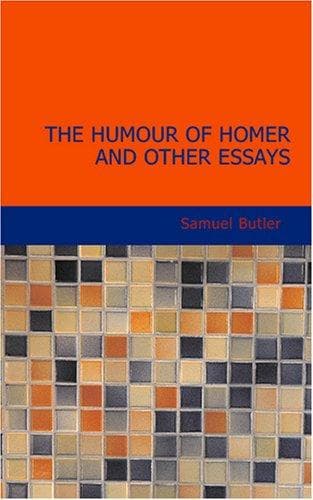
The Humour of Homer and Other EssaysButler, Samuel
History
The Humour of Homer and Other Essays
Butler, Samuel
Essays; Greek wit and humor -- History and criticism; Homer -- Humor
"Certain observations on the embryology of the lower animals are
held to afford direct proof of this theory of heredity, but they are
too technical to be made clear to ordinary readers. A logical
result of the theory is the impossibility of the transmission of
acquired characters, since the molecular structure of the germ-plasm
is already determined within the embryo; and Weismann holds that
there are no facts which really prove that acquired characters can
be inherited, although their inheritance has, by most writers, been
considered so probable as hardly to stand in need of direct proof.
"We have already seen in the earlier part of this chapter that many
instances of change, imputed to the inheritance of acquired
variations, are really cases of selection."
And the rest of the remarks tend to convey the impression that Mr.
Wallace adopts Professor Weismann's view, but, curiously enough,
though I have gone through Mr. Wallace's book with a special view to
this particular point, I have not been able to find him definitely
committing himself either to the assertion that acquired
modifications never are inherited, or that they sometimes are so.
It is abundantly laid down that Mr. Darwin laid too much stress on
use and disuse, and a residuary impression is left that Mr. Wallace
is endorsing Professor Weismann's view, but I have found it
impossible to collect anything that enables me to define his
position confidently in this respect.
This is natural enough, for Mr. Wallace has entitled his book
Darwinism, and a work denying that use and disuse produced any
effect could not conceivably be called Darwinism. Mr. Herbert
Spencer has recently collected many passages from The Origin of
Species and from Animals and Plants under Domestication," {263}
which show how largely, after all, use and disuse entered into Mr.
Darwin's system, and we know that in his later years he attached
still more importance to them. It was out of the question,
therefore, that Mr. Wallace should categorically deny that their
effects were inheritable. On the other hand, the temptation to
adopt Professor Weismann's view must have been overwhelming to one
who had been already inclined to minimize the effects of use and
disuse. On the whole, one does not see what Mr. Wallace could do,
other than what he has done--unless, of course, he changed his
title, or had been no longer Mr. Wallace.
Public-domain text, read in full here on John Shaqi.
Reviews
Reviews
No reviews yet
Be the first to share your thoughts on this work.
Elsewhere in the archive
Join the Discussion
Join the discussion
Sign in to leave a comment or review.
Sign InorCreate an account