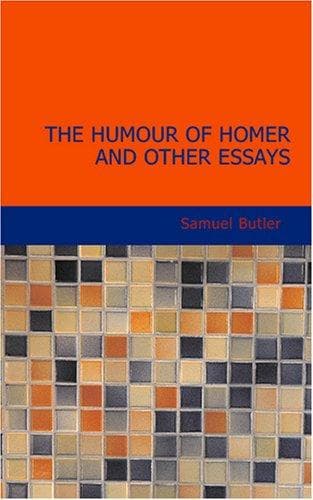
The Humour of Homer and Other EssaysButler, Samuel
History
The Humour of Homer and Other Essays
Butler, Samuel
Essays; Greek wit and humor -- History and criticism; Homer -- Humor
As for their own unconsciousness I do not deny it. The life of the
embryo was unconscious before birth, and so is the life--I am
speaking only of the life revealed to us by natural religion--after
death. But as the embryonic and infant life of which we were
unconscious was the most potent factor in our after life of
consciousness, so the effect which we may unconsciously produce in
others after death, and it may be even before it on those who have
never seen us, is in all sober seriousness our truer and more
abiding life, and the one which those who would make the best of
their sojourn here will take most into their consideration.
Unconsciousness is no bar to livingness. Our conscious actions are
a drop in the sea as compared with our unconscious ones. Could we
know all the life that is in us by way of circulation, nutrition,
breathing, waste and repair, we should learn what an infinitesimally
small part consciousness plays in our present existence; yet our
unconscious life is as truly life as our conscious life, and though
it is unconscious to itself it emerges into an indirect and
vicarious consciousness in our other and conscious self, which
exists but in virtue of our unconscious self. So we have also a
vicarious consciousness in others. The unconscious life of those
that have gone before us has in great part moulded us into such men
and women as we are, and our own unconscious lives will in like
manner have a vicarious consciousness in others, though we be dead
enough to it in ourselves.
Public-domain text, read in full here on John Shaqi.
Reviews
Reviews
No reviews yet
Be the first to share your thoughts on this work.
Elsewhere in the archive
Join the Discussion
Join the discussion
Sign in to leave a comment or review.
Sign InorCreate an account