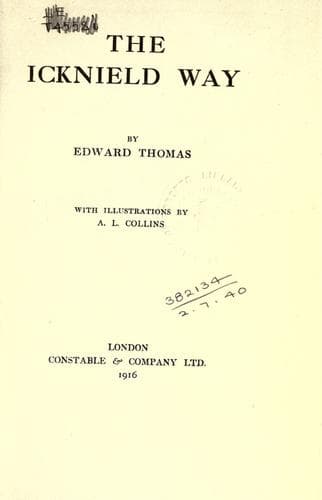
England -- Description and travel; Icknield Way (England); Thomas, Edward, 1878-1917
There were several pictures of scenery. One showed a steep and very
romantic forest road. It was deep in snow, and enormous trees, whose
roots were nourished in Hades, towered up above on either hand, but let
in the light of a full moon that shone straight down the road. Towards
the moon and up the road went a tall, mantled traveller, leaning on
a staff and turning his head to look into the wood. The picture had
no name, text, or explanation. It was a nameless man and a nameless
traveller, both unknown to history. Nothing was happening. It was
simply a combination of four or five grand, simple elements; a mighty
forest--a moon--snow--a solitary road--a tall traveller.
One of the other pictures was the same, except that a foaming river
took the place of the snowy road. The forest and the moon were the
same. The traveller was not there, and to one who had seen the last
picture there was a touch of tragedy in his absence which atoned for
it; he might have been surprised at the very moment when the snowy
road was being changed into a foaming river. Those who had not seen the
other had to be content with a moon, a romantic forest, a river running
down through it, and foam instead of snow. It hardly seemed to me to
be enough--lacking the human interest. A small flock of sheep among
the trees, with or even without a shepherd, would have made a vital
difference, and the picture could then also have been recognized by
purchasers and recipients of Christmas cards. And this picture was one
which would appeal to those who knew the kind of thing depicted. Rough
woodlanders and their wives, people who have suffered in snow, poor men
who have travelled alone and leaned on their staffs, would gladly put
both pictures on their walls. There were photographs of such people on
the mantelpiece, people whom no best clothes or photographer’s polish
could turn into poetic heroes or cigar-box beauties; men with queer
hairy faces, legs bent like oak branches, and eyes squinting at the
photographer; women their equals, but if anything more hardened, more
tortured, more smiling upon the occasion of being photographed.
Public-domain text, read in full here on John Shaqi.
Reviews
Reviews
No reviews yet
Be the first to share your thoughts on this work.
Elsewhere in the archive
Join the Discussion
Join the discussion
Sign in to leave a comment or review.
Sign InorCreate an account