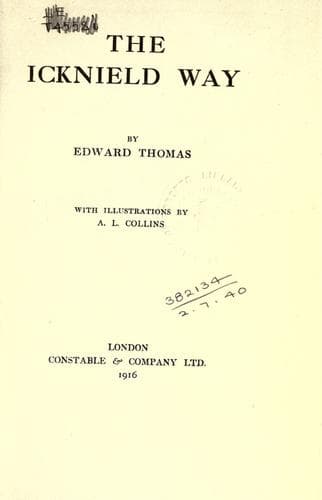
England -- Description and travel; Icknield Way (England); Thomas, Edward, 1878-1917
When I went into one of the inns there was a woman seated in the
taproom drinking beer, a shrill and lean, large-eyed woman of middle
age, somewhat in liquor, and with ill-fitting boots, in which she had
walked fifteen miles and had nine still to do. Whether or not because
he had drunk more, her husband had gone on by train; she said she had
“sent him.” She foresaw that it was not going to rain that day. She
claimed no credit for the foresight. Her corns alone had the power. In
about a quarter of an hour she left. She was a woman that walked fast
but stopped often. She carried her hands in the pockets of her black
skirt. Not long after she had started the rain fell down upon her, as
it did upon the roofs, mackintoshes, and umbrellas of the brewers,
publicans, and brewery shareholders.
From the west of Blewbury to Upton there was another mile of broad,
green tracks through corn, without a tree between them and the round,
smooth downs, with their tumuli clear against the sky on the left hand.
At Upton this series of roads from Little Stoke entered the main road,
or crossed it, and continued without touching any villages on the way
to Lockinge and Wantage. But this further road was a continuation of
the line of the main road before it turned north to Upton and west to
Hagbourne, and might have been an alternative course to Wantage, or
part of an earlier way, perhaps the Icknield Way itself, which some
have supposed to go nearer the Downs than the main road now does. As
I meant at another time to travel this road and its parallels from
Streatley to the Wiltshire border, I returned to Blewbury, and at one
of the six inns read James Montgomery’s _Pelican Island_, a poem of
A.D. 1827, in nine cantos. The poem seemed to have been started and
carried on under the influence of an ecstasy given to the author by
an explorer’s book. In his _Voyage to Terra Australis_, then not long
published, Captain Matthew Flinders had described two little islands,
the breeding-place and antique cemetery of pelicans, “islets of a
hidden lagoon of an uninhabited island, situate upon an unknown coast,
near the antipodes of Europe.” This evidently impressed Montgomery with
a strong feeling of solitariness. He imagined himself alone when “sky,
sun, and sea were all the universe,” himself a spirit, “all eye, ear,
thought”--“what the soul can make itself at pleasure, that I was.” For
“thrice a thousand years” he saw none but the people of the sea:--
Beings for whom the universe was made,
Yet none of kindred with myself. In vain
I strove to waken sympathy in breasts
Cold as the element in which they moved,
And inaccessible to fellowship
With me, as sun and stars, as winds and vapours.
Under the sea also he saw:--
Relics huge and strange
Of the old world that perish’d by the flood,
Kept under chains of darkness till the judgment.
Public-domain text, read in full here on John Shaqi.
Reviews
Reviews
No reviews yet
Be the first to share your thoughts on this work.
Elsewhere in the archive
Join the Discussion
Join the discussion
Sign in to leave a comment or review.
Sign InorCreate an account