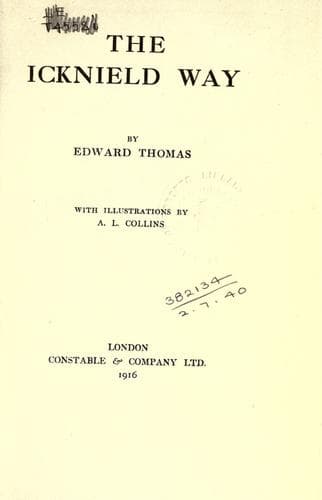
England -- Description and travel; Icknield Way (England); Thomas, Edward, 1878-1917
Lone Barn has since been burnt to the ground, and should Francis Albert
Edward (his real name) or the world visit the scene of his nativity,
to worship or verify the facts, they would find in that hollow of the
downs only a square space of nettles, poppies, and bachelor’s buttons,
amidst the turf....
Coming to the telegraph posts of Abingdon Lane--the Abingdon and
Newbury road--the turf was furrowed this way and that. Gorse and thorn,
surrounding the crossing of the straight, white road and the green
way, made a frame as for some wayside event of no common kind, such as
the birth of Francis; but the sun shone and the wind blew and betrayed
nothing. Then the road was a central track of very little rutted turf,
and flowers and long grass on either side; it had banks, but no thorns
growing on them. The valley was beautiful, the mile-distant tedded hay
looking like sea sand, the elms very dark in their lines or masses
above the green corn, the villages hidden and the single farm-houses
dim among trees, and the land rising beyond to a ridge saddled here and
there with dark clumps on the horizon. In one place a far-off upland of
newly ploughed chalk was almost snowy in misty whiteness. The clouds
of the sky and the hot mist of earth dimmed the pale ploughland and
the corn until the trees appeared to be floating on them as on a sea.
They were cutting hay a little way off to my left, and as the horses
and the mowing-machine came into sight at some speed it seemed to me
that but for the seat it was probably much like a British war chariot.
To the right the slope of the down was turf. Sometimes the road had
a bank on each side, sometimes only on one; near the crossing of the
road to East Hendred it was for a time without a bank; in other places
the ditch was clearer than the bank. There was corn with its poppies,
white campions, and charlock on the right, hay on the left. Woods,
now on the left and now on the right, sometimes touched the road; but
they never reached it from both sides at once--it never passed through
a wood. In one of the roadside woods on the left a great tumulus
stood disembowelled among the beeches: this was Scutchamer Knob on
Cuckhamsley Hill--or, as I have heard it called, “Scotchman’s Hob.”
This name an old carter had apparently justified to himself in part
by the fact that an old road coming from the north--perchance from
Scotland--passes close by, namely Hungerford Lane, which has a separate
existence from Milton Hill near Steventon to Land’s End on Knoll End
Down near Farnborough.
Public-domain text, read in full here on John Shaqi.
Reviews
Reviews
No reviews yet
Be the first to share your thoughts on this work.
Elsewhere in the archive
Join the Discussion
Join the discussion
Sign in to leave a comment or review.
Sign InorCreate an account