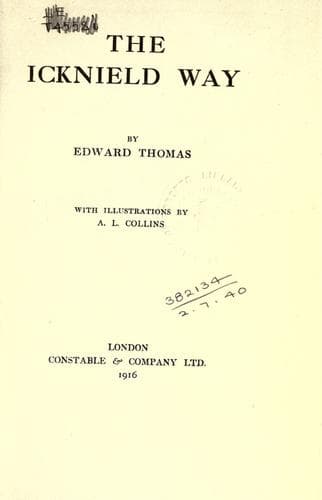
England -- Description and travel; Icknield Way (England); Thomas, Edward, 1878-1917
As I had had as much rain as I wanted on my skin, I turned downhill
under a long train of Lombardy poplars and very lanky ash trees into
East Hendred for the night. It was a thatched village built on the
slopes of a little valley, its houses standing snugly or in short rows
high above either side of the steep streets. They stood high because
the streets were very old and worn into deep hollows, and at the
edges of these ran narrow, cobbled paths; but the cottages were still
higher up, and four or five stone steps led up from the paths to their
doors. At the bottom stood the towered church, telling the hours and
the quarters, not with clock-face and hands, but with bells. Rain,
however, drowned that sweet noise in a mightier sweetness, heavy and
straight rain, and no wind except what itself created. For half an hour
everything--trees, mud walls, thatch, old weatherboards, pale-coloured,
timbered cottages, the old chapel at a crossing railed off as a sign of
private possession--everything was embedded in rain. Every sound was
the rain. For example, I thought I heard bacon frying in a room near
by, with a noise almost as loud as the pig made when it was stuck; but
it was the rain pouring steadily off the inn roof. Then in the dripping
quiet afterwards the sunset blazed in little fragments like gorgeous
glass and metal betwixt the black garden foliage.
Before I went to bed an intelligent, unprejudiced man told me that the
field-way I had followed was Ickleton Street or--he said it with some
shyness--Ickleton Meer. I had asked no leading questions, so that his
name seemed certainly the local though perhaps not invariable one. From
his description and map knowledge I felt no doubt that this was the
road mentioned in Wise’s _Antiquities of Berkshire_ (1695) as ploughed
up in Wantage east field, but visible from Lockinge Park, eastward
almost the whole way to Upton, through the parishes of Ardington, East
Hendred, Harwell, and West Hagbourne.
Public-domain text, read in full here on John Shaqi.
Reviews
Reviews
No reviews yet
Be the first to share your thoughts on this work.
Elsewhere in the archive
Join the Discussion
Join the discussion
Sign in to leave a comment or review.
Sign InorCreate an account