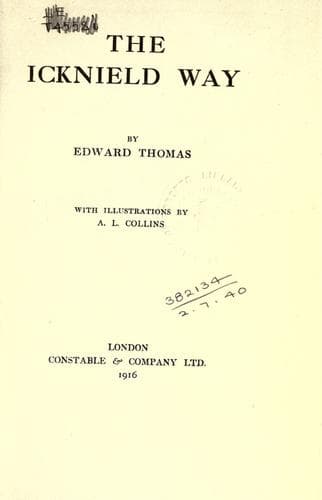
England -- Description and travel; Icknield Way (England); Thomas, Edward, 1878-1917
I stopped for a little time at Ashbury, and asking for tea at a cottage
and shop combined, I was asked into a silent but formidable Sunday
assembly of three incompatible and hostile but respectful generations:
a severe but cheerful grandmother in black and spectacles with one
finger still marking a place in the Bible; a preoccupied, morose
mother, also in black; a depressed but giddy daughter fresh from the
counter of a London shop, and already wondering what she was going
to do at Ashbury. This girl poured out my tea and told me that there
were some very good apples on the tree next door. Neither she nor her
relatives, because it was Sunday, could buy these or in any way procure
them, so she told me, though she had begun to want them very much
after half a day at her native village; if I went--and there seemed
no objection to the damnation of a casual wayfarer--I could probably
get some. The old lady who lived in the cottage next door said, as if
she were stating a well-known fact in the natural history of Ashbury,
that she had no apples, that they were very troublesome to knock down,
that none had fallen from the trees during the day, and that--she
was perfectly certain--there would be none until the morrow. On the
morrow I hoped to be many miles from Ashbury, and so I wished her a
good afternoon in spite of the rigid sabbatarianism of her trees. I
returned to the cottage where I had been drinking tea and told the girl
that no apples would fall until Monday morning, and asked her if she
knew any other kind of apple trees in Ashbury. Perhaps it was as well
that she did not, for I found that Sunday’s tea cost twice as much as
Saturday’s or Monday’s--it being apparently the right of the righteous
to prey upon the damned, even if in so doing they put themselves into
a position apparently as graceless as that of the damned. I thought
of asking a clergyman if this was so, and seeing a man whom I took to
be a clergyman, because his collar was fastened behind instead of in
front, I walked after him. But he suddenly stopped and went into the
very cottage of the old lady whose apples would not fall before Monday
morning, and this looked so like a conspiracy that I hastened away,
glad to have made these discoveries in the natural history of Ashbury.
[Illustration: Coombe at Bishopstone.]
Public-domain text, read in full here on John Shaqi.
Reviews
Reviews
No reviews yet
Be the first to share your thoughts on this work.
Elsewhere in the archive
Join the Discussion
Join the discussion
Sign in to leave a comment or review.
Sign InorCreate an account