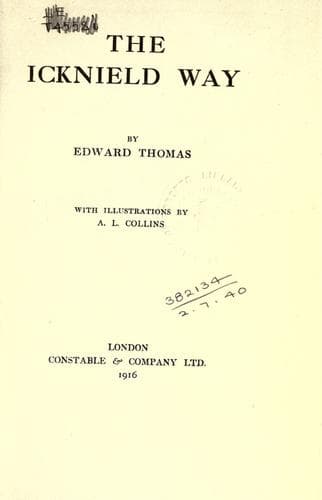
England -- Description and travel; Icknield Way (England); Thomas, Edward, 1878-1917
Sheep were strewn over some of these terraces, making arrangements of
white dots of a fascinating irregularity. Unless it has become a trick,
only a great artist could make similar arrangements of equal beauty.
The unknown laws which produce these inevitable accidents are great
managers of the beautiful. The succession of bays in an island coast
and the general form of the island itself--of course, particularly of
islands off our own coast--are beautiful in their way. The shape of
England and Wales, the shape of Ireland, of Man, and of the whole
flock of the Hebrides please me with their unity, fascinate me with
their complexity; a mistaken map of any such known place is as bad
æsthetically as geographically. Children are fond of inventing islands
with marvellous inlets more romantic than anything on the west coast of
Scotland or Scandinavia. But I have never seen one of these invented
islands that I could like apart from its creator, or its names, or its
sites marked “Buried gold,” and so on. They are incredible and raise
no wonder. They are not masters’ work. I do not know if geologists can
support me, but Leonardo’s Cave in “The Virgin of the Rocks” always
makes me uneasy by what seems to me to be its artificial impossibility.
Another great picture which is, I think, faulty in a similar way
reminds me of another beauty--the beauty of the scattering and
gathering of the stars. I never look at Titian’s “Bacchus and Ariadne”
without feeling the constellation in that glorious purple is an unhappy
invention. It may be my poor astronomy, but I should be inclined to say
that stars never could be spread exactly as they are in that picture.
It is not merely that there is (I believe) no such constellation, but
that the form is one which, for some reason, they would avoid, though
by picking a star here and a star there it might be patched up. Birds
always fly and fishing-boats always sail in these just patterns.
Some are so just that, like that of the sheep above Bishopstone, I
should like to have them copied on paper to look at for their mystical
arithmetic.
The village, the mill, and the church were lower down to the right
below the spring, on the modern road and its northward branches. Only
a cottage, with a thatched roof on a level with my feet, lay near the
green coombe track above the water. The road went on again between
corn and roots, westwards now, and gradually farther from the Downs,
until a cross-road from Bourton cut across it and sent it southwards a
quarter-mile by a willowy spring before it turned west again.
Public-domain text, read in full here on John Shaqi.
Reviews
Reviews
No reviews yet
Be the first to share your thoughts on this work.
Elsewhere in the archive
Join the Discussion
Join the discussion
Sign in to leave a comment or review.
Sign InorCreate an account