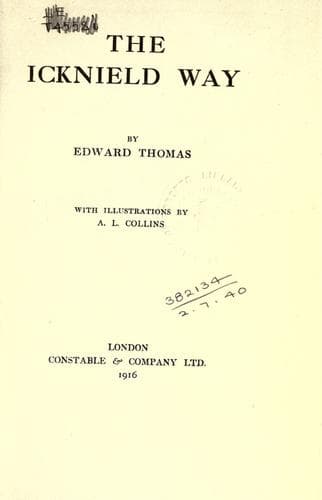
England -- Description and travel; Icknield Way (England); Thomas, Edward, 1878-1917
it was an irregular space of two or three square miles, nearly level
but not quite. This was divided into large fields of grass or corn by
scarce perceptible hedges or ditches, and crossed by one winding road
visible and white at only one of its bends. Along this road and the
hedges a very few elms were distributed with indescribable felicity.
There would be five at a bend; a row, then a break, and only one or two
more; and they made only one long line. One of the fields so divided
was lemon-coloured with charlock; on one which was slightly tilted up
a few sheep were scattered. Beyond and on either side of this space
the trees were thicker, and closed in so that two or three miles
away all seemed woodland with an interspace or two, then a grey, dim
ridge beyond, all under a grey-folded sky. Above the juniper hill the
jackdaws were jacking merrily.
[Illustration: Near the “Leather Bottle.”]
Afterwards the road descended and was a green-hedged line with a
narrow ploughed field between it and the edge of the juniper. Above
Chinnor it was for a long way almost straight, broad and green, with
elms in the left hedge. Here the Chilterns had beeches on the upper
slope and dots of juniper below. Suddenly after this straightness the
way had to descend a little over undulating ground, and it wriggled
ahead confusedly, narrow and without trees in its hedge, widening
where a hump was useless, to the ploughland below. In front now stood
the clumped Beacon Hill above Lewknor, which was the end of a long
curve of hills carrying the woods of Crowell, Kingston, and Aston,
woods reaching from the ridge down to the arable in most parts, but
with lawny or chalky intervals. At the crossing to Kingston Blount
the railway came up to my road and from there went close and parallel
for a mile to the station of Aston Rowant. It was here a broad green
track at the foot of the slope, though still above everything lying
on its right, and leaving the villages at least half a mile on that
side. It rounded Beacon Hill, which was capped with a tree-clump and
sprinkled with junipers, and went along under Bald Hill and Shirburn
Hill, which was wooded. Before crossing the road from Great Marlow and
Fingest to Watlington, it wound round a chalk pit and rubbish heap.
Then the telegraph-posts joined it, though it was only a green lane in
two terraces going under thorny Watlington Hill, and past cornfields
sprinkled with charlock and white campion. At one point ten elm trees,
one a triple tree, stood out in the middle of the wide green trackway.
Beyond the road from Nettlebed the way was white between high, level
green banks, and then long grass, thistles, and thorns in a thicket,
before coming to the elm-shaded pond where a lane goes up on the left
under more elms to Dame Alice Farm. Then it narrowed and widened again
among nettles and elder, and a little farther it became a company
of four parallel grooves paved with the pure down turf, a little
silver-weed, and thyme.
Public-domain text, read in full here on John Shaqi.
Reviews
Reviews
No reviews yet
Be the first to share your thoughts on this work.
Elsewhere in the archive
Join the Discussion
Join the discussion
Sign in to leave a comment or review.
Sign InorCreate an account