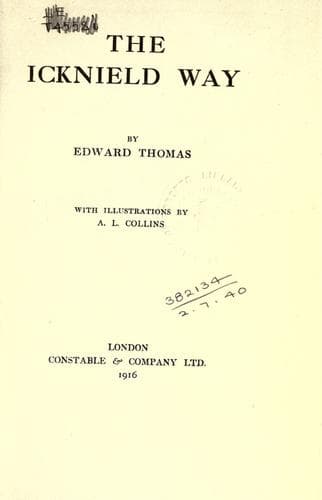
England -- Description and travel; Icknield Way (England); Thomas, Edward, 1878-1917
Birds in those branches did sing,
Blackbird and throstle and linnet,
But she walking there was by far the most fair--
Lovelier than all else within it,
Blackbird and throstle and linnet.
But blossoms to berries do come,
All hanging on stalks light and slender,
And one long summer’s day charmed that lady away
With vows sweet and merry and tender,
A lover with voice low and tender.
Moss and lichen the green branches deck,
Weeds nod in its paths green and shady;
Yet a light footstep seems there to wander in dreams,
The ghost of that beautiful lady--
That happy and beautiful lady.
As if I had not had enough of it in passing through, I walked out again
to Cleeve, and looked at the blocks of red brick houses. Only people
with immortal souls could be content with houses like those. For a man
without an immortal soul, but a few senses for a substitute, a house
like one of these is, to use one poor word instead of a dozen better
ones, unsuitable. I have lived in three, and one of them would compete
with any house at Cleeve for the title of The Red Brick House.
The Red Brick House was a raw naked building in the county of Kent with
a triple bay window to left and right of the front door, and, above
these, two large windows and a small one in the middle; on one side
there were no windows, on the other only one very small one low down;
the back was flat and had a door between a large window and a small,
and three windows above. The roof was of slate and low-pitched, and
there was a stack with three chimney pots at either side of the house,
and a single chimney at the back.
The house stood in a level, oblong piece of land cut out of a large
field by posts and wire, and separated from the road by a cheap but
rustic fence. There were two other buildings of the same species within
two hundred yards, all looking across the same road between elm trees
to a ploughed field, many hedges, a rise of orchard land, and some
heavy wooded hills at the horizon. For the sake of the houses the elms
on their side had been felled and taken away. Breaking-down, temporary
fowl-houses were littered about two of the gardens, which someone had
begun to dig once upon a time, and even to plant and sow; but there was
not a living tree in either of them.
The soil was light. There was no higher ground in the near
neighbourhood, and it had therefore been chosen as the site of a square
water-tank, imperfectly sequestered among elms close to the house. To
the south the view was gentle and perfect, especially when the blossom
snow hung in the orchards and the sky was milky soft above the dark
woods of the horizon. At the lower edge of these woods stood a white
house that was always mysterious, even though it was often seen from
a gateway not a hundred yards distant. The Downs flowed to the north.
Eastward and westward the last undulations of the Downs could be seen
beyond orchards and elms.
Public-domain text, read in full here on John Shaqi.
Reviews
Reviews
No reviews yet
Be the first to share your thoughts on this work.
Elsewhere in the archive
Join the Discussion
Join the discussion
Sign in to leave a comment or review.
Sign InorCreate an account